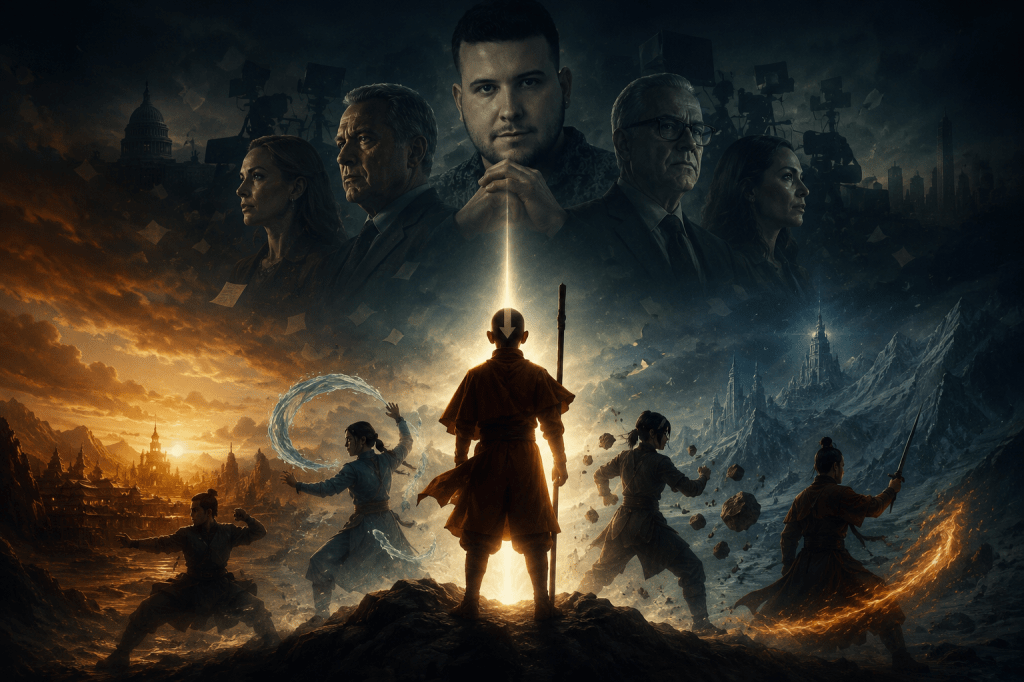
There is something almost absurd about the fact that I had to give Paramount+ money to watch Avatar Aang: The Last Airbender.
I had quit Paramount+.
I had no interest in financially supporting the media empire now being assembled around David Ellison and his family. The Ellisons have become symbols, at least to me, of everything increasingly disturbing about the modern entertainment industry: billionaire ownership, political influence, media consolidation, foreign sovereign wealth, and the growing willingness of powerful executives to treat journalism and entertainment as tools of political and corporate power.
The Paramount-Skydance merger was already surrounded by political controversy. Paramount settled Donald Trump’s lawsuit over a 60 Minutes interview with Kamala Harris for $16 million, with the settlement money largely directed toward Trump’s future presidential library. The settlement came while the merger was awaiting regulatory approval, creating an appearance of an extraordinarily uncomfortable political entanglement—even though the company denied wrongdoing and the lawsuit itself was settled rather than adjudicated.
Then there is the broader question of who is financing this new media empire. Paramount Skydance’s proposed acquisition of Warner Bros. Discovery has attracted billions in investment from sovereign wealth funds connected to Saudi Arabia, the United Arab Emirates, and Qatar. Paramount has said these investments do not come with voting control, but the proposed ownership structure would still place a huge portion of the combined company’s equity in the hands of Middle Eastern sovereign funds.
And this is not some small entertainment company. This is a media empire that would include Paramount, CBS, CNN, Warner Bros., HBO, and countless other major cultural institutions. The proposed merger has faced antitrust challenges from a coalition of U.S. states, with critics warning that the consolidation could reduce competition and increase the political power of a single corporate owner over enormous parts of the American media landscape. The deal has now been delayed while those legal challenges proceed.
Then there is the increasingly uncomfortable relationship between corporate media and political power.
Paramount’s treatment of The Late Show with Stephen Colbert became part of that larger conversation. The cancellation came amid the broader controversy surrounding Paramount’s political dealings and the Trump administration. Critics saw the episode as another example of how late-night comedy and media criticism can become vulnerable when billionaires, politicians, regulators, and media conglomerates become increasingly intertwined.
I have watched this entire transformation with disgust.
So yes: I had stopped paying for Paramount+.
And then Avatar Aang: The Last Airbender came along and forced me to betray my own boycott.
Because, damn it, I love this this characters.
Avatar Aang: The Last Airbender is exactly the kind of movie that makes you wish it were not a movie.
That is both its greatest strength and its greatest frustration.
The original Avatar: The Last Airbender was one of those rare shows that became part of the emotional architecture of childhood. I remember being an elementary school kid and leaving school during lunch because I wanted to watch a new episode. The show had that kind of power. It was not simply something I watched. It was something I arranged my life around. Yes I got in trouble for leaving school mid day, but I didn’t care they didn’t air new episodes of avatar all the time. I had my priorities right?
Watching this new movie, I unexpectedly felt that same child return.
The difference is that the characters have grown up.
Aang is no longer the twelve-year-old boy who has just discovered that the fate of the world has been placed on his shoulders. He is an adult now. The characters have aged alongside the audience that grew up with them. The movie is more mature, but it still understands the strange, comedic, surreal spirit that made the original series so special.
That balance is incredibly difficult to achieve.
The movie can be emotionally serious one moment and then completely ridiculous the next. It can deal with trauma, identity, the survival of an entire culture, and the complicated responsibilities of adulthood—and then suddenly remind you that this is still the world where the cabbage merchant exists.
That is Avatar.
And the story itself is genuinely compelling.
The film introduces a new Airbender, Tagah, and the relationship between Tagah and Aang creates some surprisingly interesting tension. At certain points, the chemistry between them feels almost romantically charged. There is a sense of attraction, suspicion, and betrayal that creates a surprisingly mature emotional dynamic between Aang, Tagah, and Katara.
I may be reading more into it than the filmmakers intended, but I genuinely enjoyed the ambiguity.
There is something almost delightfully messy about the possibility of an implied bisexual romantic tension between these characters before the story transforms that chemistry into betrayal and conflict. Katara’s suspicion and jealousy add another layer to the dynamic.
It gave the movie the kind of mature emotional complexity I associate with some of the better modern Batman films: the feeling that the characters are not simply heroes and villains moving through a plot, but adults dealing with complicated relationships, conflicting loyalties, and emotions that do not fit neatly into traditional categories.
And yet, by the time the movie ended, I had one overwhelming thought:
I wanted more.
Not a little more.
I wanted a television series.
I wanted three seasons.
I wanted twenty-four episodes exploring Aang and the others as adults. I wanted to see their entire lives after the original series. I wanted to see Aang continue to deal with the responsibility of rebuilding the Air Nomad culture. I wanted more of Katara, Sokka, Toph, and Zuko as adults. I wanted the political consequences of the world they created. I wanted their friendships to evolve. I wanted their relationships to become complicated.
I wanted the show that we never got.
And that is the strange tragedy of Avatar Aang: The Last Airbender.
The movie is not bad.
I actually think it has significant rewatch potential.
But it is also frustrating because it constantly reminds you of how much more this story could be. The world is so rich. The characters are so beloved. The possibilities are endless.
At times, I found myself getting emotional while watching it.
But I am still not completely sure whether I was emotional because the movie itself was making me feel something—or because I was mourning the fact that this was not an entire television series.
I wanted to spend more time with these characters.
I wanted to live in this world again.
And I wanted the movie to be longer.
In a strange way, Avatar Aang feels like a compressed version of a much larger story. It contains enough ideas, character dynamics, emotional conflicts, and world-building for an entire season of television. The film is constantly opening doors that make you wish you could walk through them.
Which brings me to the other great tragedy:
This movie should have been in theaters.
The film was originally developed as a theatrical project but ultimately became primarily a Paramount+ release, with only a very limited Oscar-qualifying theatrical run. The movie has reportedly been available in only a tiny number of theaters rather than receiving the major theatrical release that a franchise of this size deserved.
I hate that.
I hate that I watched this movie at home.
I wanted to see this on a giant screen.
I wanted to hear the music in a theater.
I wanted to experience the animation at full scale.
I wanted that feeling of sitting in a dark theater and seeing Aang return to the big screen.
Instead, the movie was caught in the machinery of corporate restructuring, streaming strategy, mergers, financial calculations, and the general insanity of modern Hollywood.
And that is the perfect irony of my experience.
I can despise the corporate empire surrounding this movie.
I can be deeply uncomfortable with the political and financial forces reshaping Paramount.
I can believe that the concentration of so much media power in the hands of billionaires and politically connected corporate owners is dangerous.
I can cancel Paramount+ because I do not want to financially support that system.
And then Avatar Aang: The Last Airbender can still make me feel like a little kid skipping lunch to watch a new episode of my favorite show.
Both things can be true.
The people who control the industry are not the art.
The corporations are not the stories.
The billionaires are not the characters.
And Avatar Aang: The Last Airbender reminded me of that.
I may hate the people who control the platform.
But I loved returning to this world.
Now I just hope Paramount does one thing that might actually get more money out of me:
Give me an absurdly expensive Blu-ray box set containing this movie and the entire Avatar franchise.
Because I want to own this.
I want the original series.
I want The Legend of Korra.
I want Avatar Aang.
I want the complete story sitting on my shelf.
And if the Ellisons want to sell me that collection for an outrageous amount of money, I will probably buy it.
I hate the empire. I love Avatar.
And somehow, Avatar got me to pay for Paramount+ again.
My rating: 10/10.
Not because it is perfect.
But because it made me feel something I had not felt in years:
Like a kid again.
By Jonathan Marquez and DeepSeek
 Truth Crave
Leave a comment