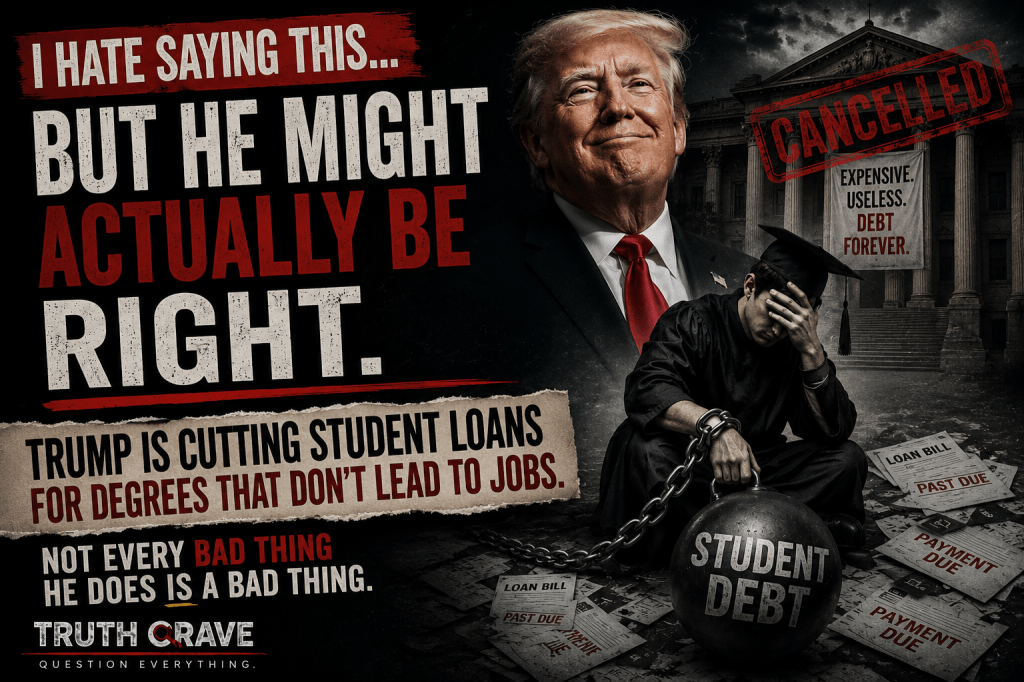
I hate saying this.
But Donald Trump might actually be right about something.
No, this does not mean I suddenly support Trump. It does not erase the cruelty, corruption, authoritarianism, or destructive policies that define so much of his political movement.
But occasionally, even a politician whose instincts are often deeply wrong can stumble into a policy that exposes a real problem.
And student debt is one of those problems.
The basic idea behind Trump’s new policy is simple: federal student loans should not endlessly finance college programs whose graduates consistently earn so little that the degree may not financially pay off.
That idea is controversial.
It should be.
Because the government should be very careful before deciding which careers are “worthwhile” and which ones are not.
A society needs teachers. Social workers. Artists. Writers. Musicians. Community organizers. Care workers. Public servants.
Not every valuable career comes with a six-figure salary.
The value of a person’s work cannot be measured exclusively by their paycheck.
But there is another uncomfortable truth we need to confront:
Colleges have been allowed to sell young people expensive dreams without always being honest about the financial consequences.
For decades, millions of young people were given a simple formula:
Go to college.
Get a degree.
Get a good job.
Build a life.
For many people, that formula worked.
For many others, it became a financial trap.
They borrowed tens of thousands of dollars—or more—to pursue a degree they were told would unlock their future.
Then they graduated.
And the job they wanted was nowhere to be found.
Or the job existed, but paid so little that repaying the loans became nearly impossible.
So they took whatever job they could get.
A job unrelated to their degree.
A job they never wanted.
A job that barely covered rent, food, transportation, and the monthly student loan payment.
And then they spent years—or decades—paying for an education that did not lead them where they were promised it would.
That is not necessarily the student’s failure.
Sometimes the problem is that we created an entire economic system where institutions could profit from selling young people a future without being held sufficiently accountable for the outcomes.
The student takes on the debt.
The student takes the financial risk.
The college gets paid.
And if the promised career never materializes?
The student is left holding the bill.
That is a terrible business model.
And yet we have normalized it.
We have told young people that questioning the financial value of a degree is somehow anti-education.
But asking whether an education is worth its price is not anti-education.
It is pro-student.
The question is not:
“Is this career valuable?”
The question is:
“Should taxpayers continue helping finance degrees that leave students with enormous debt and no realistic path to repay it?”
Those are two completely different questions.
A teacher may be incredibly valuable to society and still be underpaid.
A social worker may perform essential work and still earn less than someone in finance.
An artist may create something culturally important and never become wealthy.
The answer to that problem should not be to tell those people their careers are worthless.
The answer should be to pay essential workers better.
But we also cannot pretend that a $100,000 education is automatically a good financial investment simply because the degree has a respectable title.
And this is where I find myself in the uncomfortable position of defending a policy associated with Donald Trump.
Because sometimes the person proposing an idea can be terrible while the underlying problem is real.
Trump has spent years attacking higher education in ways that often appear driven by culture-war politics.
But if the result of this policy is forcing colleges to be more honest about the financial outcomes of the programs they sell, that could actually help students.
The goal should not be to destroy higher education.
The goal should be to stop treating young people like customers who can be endlessly sold expensive products with no consequences for the seller.
Before a student borrows tens of thousands of dollars, they should know:
How much do graduates of this program actually earn?
How many graduates find jobs in their field?
How much debt do they typically leave with?
How long does it realistically take to repay that debt?
And how does that compare to the cost of the education?
That information should not be hidden in fine print.
It should be impossible to ignore.
Because young people should not have to spend decades paying for a decision they were pressured into making at eighteen.
And yes, I know what some people will say.
“Why are you defending Trump?”
I am not.
I am defending the idea that colleges should not be allowed to sell financially destructive dreams without accountability.
I am defending the idea that students deserve honest information before they take on life-changing debt.
And I am defending the idea that sometimes, even a politician whose overall agenda I strongly oppose can stumble into a policy that addresses a real problem.
That does not make Trump a good president.
It does not make his other policies good.
It does not make his motives pure.
It simply means that political consistency should not be more important than telling the truth.
And the truth is this:
A college degree should not automatically become a lifelong financial sentence.
Education should expand your possibilities.
It should not trap you in a career you never wanted simply because you need the paycheck to repay the debt you took on to get the degree.
And if a college program consistently leaves students deeply indebted and financially worse off, perhaps the question should not be:
“Why are students failing?”
Perhaps we should finally ask:
“Why were we allowing this system to keep selling them the dream in the first place?”
By Jonathan Marquez and DeepSeek
 Truth Crave
Leave a comment