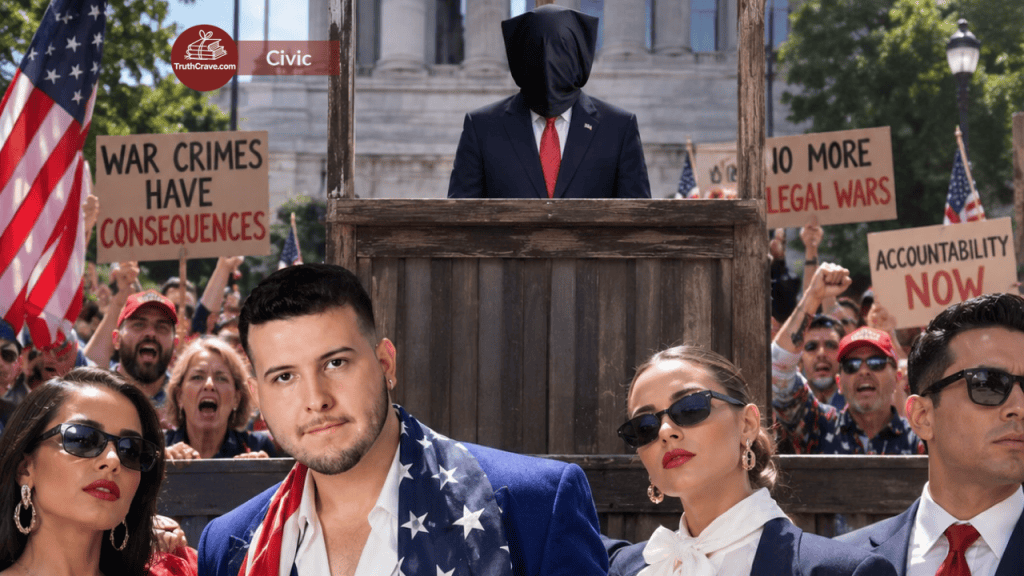
My comment on Threads received more than 600 likes before Threads removed it. What did I write?
“I literally just wrote to my representatives asking for the death penalty for presidents who started illegal wars without congressional approval.”
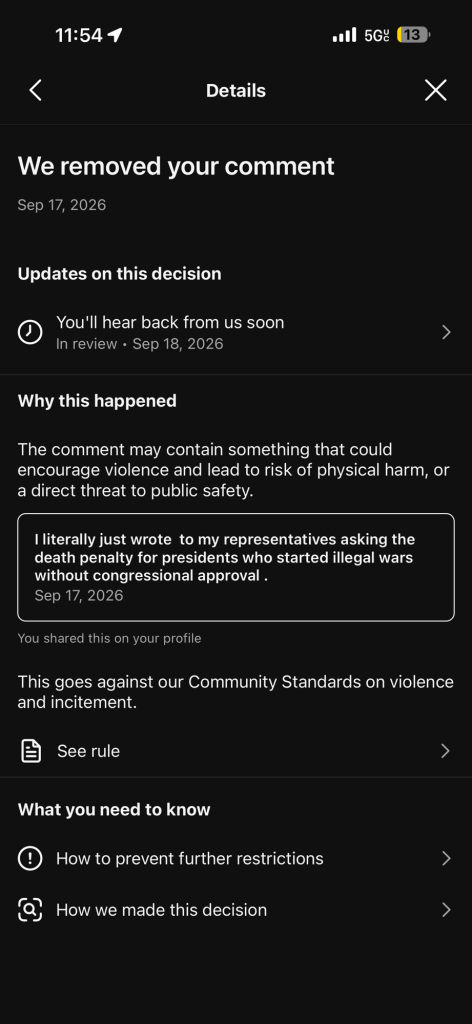
Threads said the comment “may contain something that could encourage violence and lead to risk of physical harm, or a direct threat to public safety,” and removed it under its Violence and Incitement rules.
But I wasn’t calling for anyone to assassinate a president. I was talking about a proposed legal punishment imposed through the justice system.
That distinction matters.
Meta says its Violence and Incitement policies address language that incites or facilitates serious violence, while its election-related guidance says its platforms are intended to allow political discussion. Meta has also acknowledged that its enforcement systems sometimes take a cautious approach to potentially violent language.
My larger question is not about one deleted comment. It is about something much bigger: What happens when presidents use military force without first receiving explicit congressional authorization?
The Constitution gives Congress the power to declare war, while the president serves as commander in chief. Since World War II, Congress has generally authorized major conflicts through Authorizations for Use of Military Force rather than formal declarations of war. At the same time, presidents have repeatedly asserted that they possess independent constitutional authority to conduct certain military operations without prior congressional approval.
This has happened under presidents from both parties.
During the Korean War, President Harry Truman committed U.S. forces without a congressional declaration of war. The Vietnam conflict likewise involved extensive presidential military action, although Congress passed the Gulf of Tonkin Resolution in 1964 and later enacted other measures affecting the conflict. The controversy surrounding presidential military authority during Vietnam contributed to Congress passing the War Powers Resolution of 1973 over President Nixon’s veto.
After Vietnam, presidents continued using military force without traditional declarations of war. Examples include Ronald Reagan’s intervention in Grenada, George H. W. Bush’s intervention in Panama, Bill Clinton-era military operations, and Barack Obama’s 2011 intervention in Libya. More recently, presidents including Donald Trump and Joe Biden have ordered military operations without obtaining a new, operation-specific authorization from Congress beforehand. The human cost of the Iran war cannot be reduced to constitutional arguments in Washington. In February, a strike on the Shajareh Tayyebeh girls’ primary school in Minab killed children. Iranian authorities initially reported that 53 girls were killed. Amnesty International later documented 156 people killed at the school, including 120 children, while noting it could not independently verify the total because of restrictions on access. In September, a UN fact-finding mission said there were reasonable grounds to believe U.S. forces were responsible for the strike and concluded that the attack constituted a war crime under international law. For critics who describe Trump’s Iran campaign as an illegal war, these deaths are part of the human consequences they point to not an abstract constitutional dispute.
But calling every one of these actions simply “illegal” would leave out an important part of the legal dispute. The executive branch has repeatedly argued that limited military operations can fall within presidential constitutional authority. But is the lives of 153 Irans limited military operations?. In its 2011 Libya opinion, for example, the Justice Department’s Office of Legal Counsel concluded that prior congressional approval was not constitutionally required for the limited operation it analyzed.
That is precisely why the issue deserves more public attention.
Who decides when presidential military power has gone too far?
And what happens when a president violates the limits that Congress has established?
The War Powers Resolution was specifically designed to address this problem. It requires reporting when U.S. forces are introduced into hostilities and establishes a framework under which military involvement generally must end after 60 days without congressional authorization, subject to the statute’s provisions.
Yet Americans have watched presidential administrations of both parties repeatedly test the boundaries of those powers.
That raises a legitimate democratic question: Are the consequences strong enough to actually deter presidents from exceeding congressional war powers?
My answer is that Americans should be able to debate that question openly—including debating extremely severe criminal penalties like the destruction penalty without having the discussion automatically interpreted as a personal threat.
I personally chose to write my representatives advocating for the death penalty as a potential punishment for presidents who intentionally initiate an unlawful war without congressional authorization. Others may strongly disagree with that proposal. They have every right to.
But disagreement over punishment is not the salen thing as advocating that someone be physically attacked.
But the bigger issue is accountability.
When governments send people to war, the consequences are measured in lives lost, families destroyed and communities devastated. That is precisely why the constitutional division of war powers exists in the first place.
Congress should exercise its constitutional powers regardless of which party controls Congress. And citizens should be able to demand stronger accountability mechanisms without having every discussion about criminal punishment automatically treated as a call for violence.
If presidents have the power to send Americans into war, Americans have the right to ask what legal consequences should exist when that power is abused.
That conversation shouldn’t be censored simply because it is uncomfortable for some.
 Truth Crave
Leave a comment