By Jonathan Márquez | Truth Crave
The 2026 midterm elections have given me the perfect emotional catalyst to step away from my weeklong mental health break and return to what I love doing: reporting, questioning, and documenting the world around me through Truth Crave.
And what a moment to return.
The United States has just experienced a powerful blue wave. Democrats have reclaimed control of both chambers of Congress, historic candidates have secured victories, and voters have sent a message that the political direction of this country is no longer something they are willing to accept without resistance.
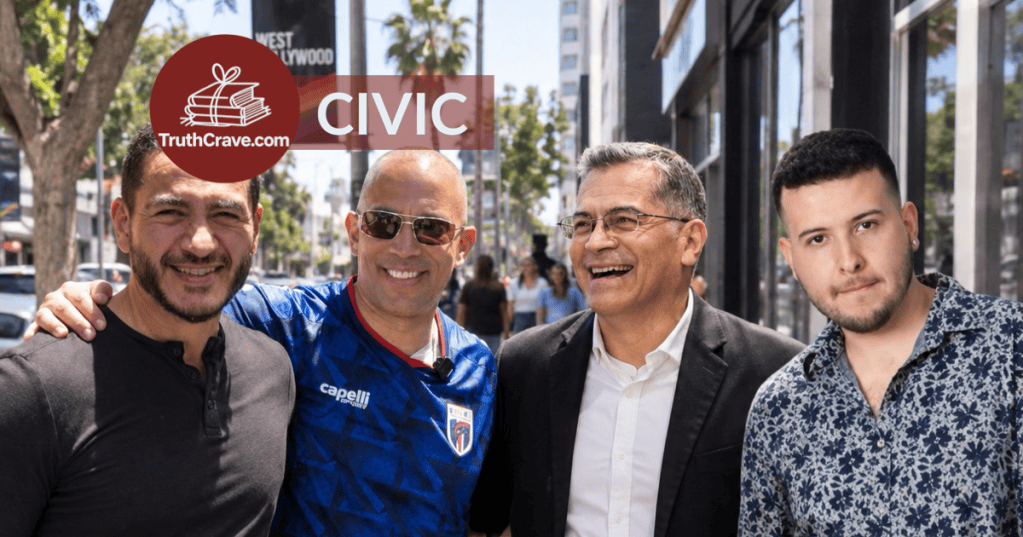
Among the victories is Xavier Becerra, who has won California’s gubernatorial election, becoming the first Latino to be directly elected governor of the state. Abdul El-Sayed has won Michigan’s Senate race, becoming the first Muslim American elected to the United States Senate. Meanwhile, Hakeem Jeffries is positioned to become the first Black Speaker of the House of Representatives.
These victories matter. Representation matters. Seeing communities that have historically been excluded from positions of political power finally occupy those spaces is worth recognizing.
But I have a difficult time celebrating these victories without asking a more uncomfortable question: Who actually won this election?
Because while I am glad to see more people of color entering positions of power, I refuse to confuse diversity in government with economic justice for the people government is supposed to serve.
There is an important historical correction worth making about California’s new governor. I have seen several reports describing Xavier Becerra as California’s first Latino governor. That statement needs clarification.
California existed as a political and cultural territory long before it became part of the United States. Before American statehood, California was part of Mexico, and Pío Pico served as its last Mexican governor. After California became a state, Romualdo Pacheco, a Californio of Mexican descent, became governor in 1875.
Therefore, Becerra is not California’s first Latino governor. He is the first Latino to be directly elected to the governorship since California became a state in the United States. That distinction does not diminish his historic victory.
Similarly, Abdul El-Sayed’s election represents a historic milestone for Muslim Americans and brings a voice into the Senate that has openly challenged American policy toward Palestine and U.S. support for Israel. At a time when the Palestinian question remains central to international politics and humanitarian concerns, his presence in the Senate is significant.
These are victories worth acknowledging. But representation alone cannot be the finish line.
I cannot ignore the influence of corporate money and private interests in American politics. Xavier Becerra’s gubernatorial campaign benefited from substantial financial support from outside groups representing powerful business interests, including corporations with significant stakes in California policymaking. That deserves public scrutiny, regardless of the candidate’s political affiliation.
I am not interested in celebrating a government simply because it looks more diverse if the economic arrangements governing people’s lives remain largely unchanged.
A working-class Latino struggling to afford rent does not experience representation as a substitute for affordable housing. A Black family unable to afford healthcare does not experience historic representation as a replacement for medical care. A family deciding between groceries and utility bills does not benefit from political symbolism alone.
And this brings me to what Democrats must understand about their newly reclaimed congressional majorities.
Restoring what Republicans took away is not the same thing as delivering progress.
If an administration takes away protections, funding, or programs that people depend on, and the next administration simply restores them, that should be the bare minimum. It is the political equivalent of cleaning up a mess someone else made. You do not get a standing ovation for wiping an ass that your predecessor left dirty.
Democrats cannot spend the next two years campaigning on the promise of returning America to where it was before MAGA. Americans need more than restoration. They need transformation.
And that transformation must begin with the most basic conditions of human survival: housing, healthcare, and food.
Why are these necessities still treated as political bargaining chips? Why should access to medical treatment, a safe place to live, or enough food to feed a family depend on which party controls Congress? Why should Americans have to repeatedly vote for politicians simply to prevent their basic needs from being taken away?
The Constitution itself establishes the promotion of the general welfare as one of the purposes of the American government. The Preamble explicitly states that the Constitution was established to promote the general welfare of the people. Article I, Section 8 also grants Congress the power to tax and spend to provide for the general welfare of the United States.
But there is a distinction we must acknowledge: these constitutional provisions do not currently establish individually enforceable rights to housing, healthcare, or food.
And that is precisely what needs to change.
If the American government is truly committed to promoting the general welfare, then why not make these fundamental necessities explicit constitutional guarantees?
Healthcare should be a right, not a privilege reserved for those who can afford insurance. Housing should be a right, not an increasingly unattainable investment opportunity. Food should be a right, not something families have to sacrifice other necessities to obtain.
I want Democrats to take this opportunity to think beyond the next election cycle. Instead of simply promising to protect existing programs, they should fight to establish lasting guarantees that no future administration can casually dismantle.
I want to see constitutional protections that place the well-being of ordinary Americans above corporate profits, political negotiations, and election-year messaging.
And I want those protections to apply regardless of who occupies the White House, who controls Congress, or which political party happens to be popular at the moment.
Because the purpose of government should not be to keep people dependent on politicians. It should be to create the conditions in which people can live with dignity, security, and opportunity.
The 2026 midterms have demonstrated that voters can change the political landscape. They have demonstrated that Republicans are not invincible, that Democratic victories are possible even in challenging political environments, and that representation in government continues to evolve.
But I am not ready to call this a victory for the American people just yet.
I will celebrate when a family can afford a home without spending most of its income on rent. I will celebrate when someone can seek medical attention without worrying about going into debt. I will celebrate when nobody has to wonder where their next meal is coming from.
I will celebrate when these necessities are no longer campaign promises, political weapons, or privileges distributed according to economic status.
Until then, a blue wave is just a change in the color of the people holding power.
The real victory will be when the people finally have power over the conditions of their own lives.


Leave a Reply