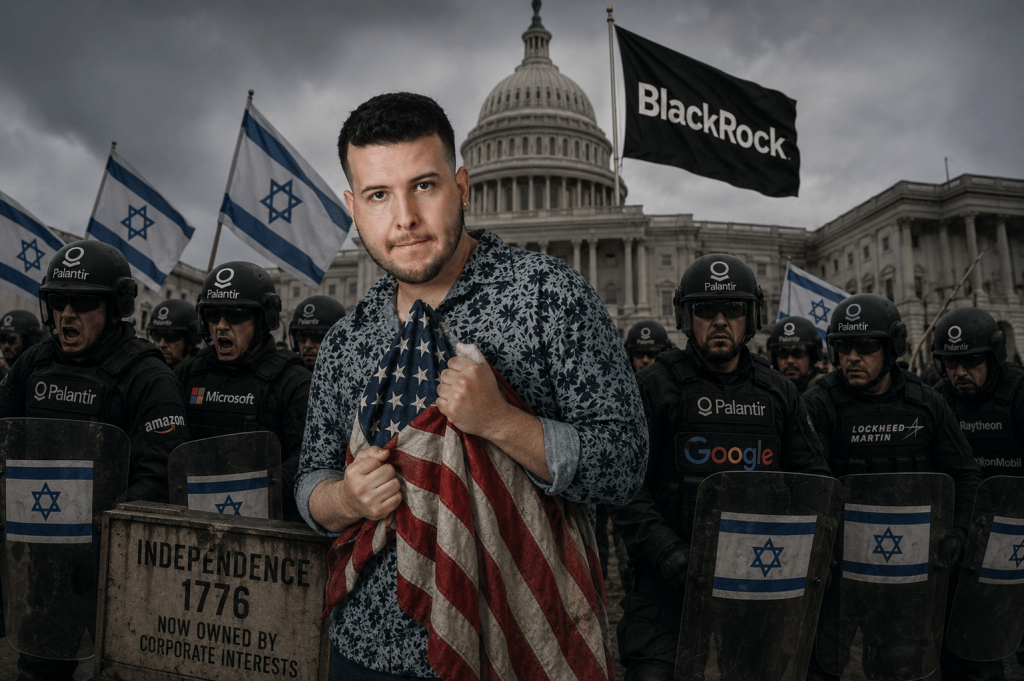
Every Fourth of July, Americans gather beneath fireworks, wave the flag, and celebrate the Declaration of Independence—a revolutionary moment when the United States broke free from the political control of the British Empire 250 years ago.
But I have a simple question.
Independent from what types of systematic estructures exactly?
History deserves to be remembered, but it should not become an excuse to ignore the present. Independence is not merely an event frozen in 1776. It is a condition that must be defended continuously. A nation can win its sovereignty once and gradually surrender it through complacency.
Today, many Americans proudly celebrate independence while refusing to acknowledge how much power has shifted away from ordinary citizens and toward corporate interests, wealthy donors, lobbyists, and, in some cases, foreign influence over public policy. It is as though we are participating in a national suspension of disbelief—choosing to believe the story we inherited rather than confronting the reality unfolding around us.
Part of the reason is that the institutions traditionally responsible for holding power accountable have changed. A free press exists not simply to report events or their owners narratives, but to investigate those who govern, expose corruption, and challenge concentrations of power regardless of political affiliation.
Too much of today’s mainstream media has abandoned that mission.
Rather than serving as independent watchdogs, mainstream media news organizations increasingly becoming nothing more than entertainment companies driven by ratings, advertising revenue, corporate ownership, and political access, they become simply propaganda. They spend endless hours amplifying partisan conflict while often giving comparatively little attention to the structural issues that shape Americans’ daily lives: corporate lobbying, regulatory capture, declining competition due to private equity, housing costs caused by private equity, healthcare affordability, stagnant wages, and the influence of concentrated wealth on public policy.
When the institutions that should question power instead become comfortable around it, they stop being the press and they become just a propaganda megaphone.
This creates an uncomfortable paradox.
Americans celebrate freedom while corporations continue expanding their influence over government. Massive lobbying operations shape legislation. Campaign financing allows extraordinary wealth to carry disproportionate political influence. Regulatory agencies are often staffed by individuals who previously worked for the industries they regulate or later return to them. Critical public infrastructure increasingly relies on oligarchs whose personal priorities may not always align with the public interest and democracy.
Meanwhile, Americans watch billions of dollars committed to military operations and foreign assistance overseas while many communities struggle with rising costs of living, aging infrastructure, unaffordable housing, inaccessible healthcare, and declining economic security. Whether one supports or opposes those expenditures, citizens have every right to ask whether America’s first responsibility should be improving the lives of Americans at home.
Questions about foreign and private influence deserve serious public debate as well. The close relationship between the United States and Israel, like relationships with any allied nation, should be open to public scrutiny and democratic debate without being treated as beyond criticism by pro Israel money sell out politicians or Zionist media. Americans should be able to ask whether U.S. foreign policy reflects American interests without those questions being dismissed outright by corrupt officials accepting endless bribes in the form of campaign donations.
At the same time, the growing integration of anti democratic technocrats technology companies into government functions should concern anyone who values democratic accountability. Companies such as Palantir Technologies and SpaceX now play increasingly significant roles in areas once managed almost exclusively by public institutions. Innovation can benefit society, but as government becomes more dependent on private corporations for essential capabilities, Americans should ask who ultimately controls critical infrastructure, who sets priorities, and who remains accountable to the public.
Sovereignty is not lost only through military invasion.
It can also erode gradually when economic power becomes political power, when corporations gain extraordinary leverage over public institutions infrastructure, when elected officials become increasingly dependent on wealthy interests, and when citizens begin accepting these changes as normal because mainstream media is helping normalize the corruption instead of doing their job at sounding the alarms.
Perhaps the greatest tragedy is not that the press was bought and killed by foreign and domestic oligarchs.
It is that many Americans became accosted to the propaganda before they became aware they where consuming foreign warfare propaganda.
We tell ourselves we live in a fully sovereign republic while ignoring the growing influence of concentrated wealth over our democratic institutions. We celebrate independence every July 4th without asking whether we are as politically independent today as we believe ourselves to be.
That is a form of national gaslighting— imposed by media institutions, but reinforced whenever uncomfortable realities are ignored in favor of comforting narratives.
Patriotism should never require pretending everything is fine.
Real patriotism requires demanding better.
The generation of 1776 did not fight merely so future Americans could celebrate their victory. They fought because they believed government should answer to the people rather than entrenched centers of power.
That principle remains unfinished in 2026.
If we truly value American sovereignty, then we should defend it not only against military threats, but also against corruption, excessive corporate influence, unchecked concentrations of wealth, and any domestic or foreign interests that undermine democratic accountability.
So this year, don’t just celebrate independence.
Ask whether we are still worthy of calling ourselves truly independent.
History gave us the promise of self-government.
Our generation must decide whether we still intend to keep it or they want to continue gaslighting themselves every July 4th telling themselves they are still an independent sovereign nation.
By Jonathan Marquez and Duck.ai
 Truth Crave
Leave a comment