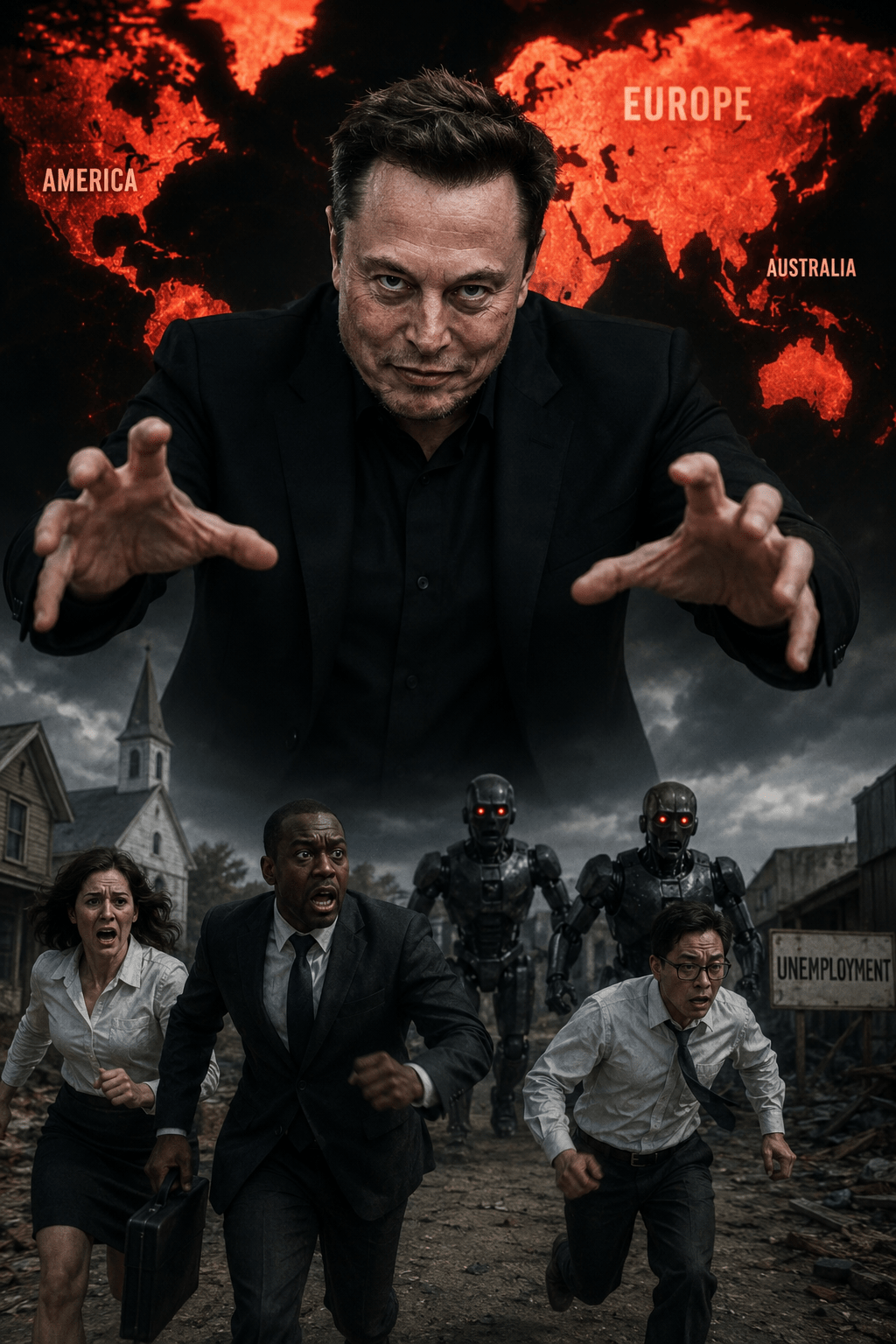
Elon Musk, the South Africa-born billionaire and CEO of Tesla and SpaceX, has long been celebrated as a tech visionary and iconoclast. However, a closer examination of his background, business practices, and recent political affiliations reveals a troubling pattern that positions him as a global threat to human rights, democracy, and economic stability.
A Legacy of Racism and Authoritarianism
Musk’s family history is steeped in ties to apartheid-era South Africa. Born in 1971 in Johannesburg, Musk was raised under the country’s institutionalized racial segregation. His grandfather, Joshua Haldeman, was a member of the Ossewabrandwag, a neo-Nazi militia sympathetic to Adolf Hitler’s regime. This group’s activities included burning Jewish businesses in Johannesburg during the 1930s . Musk’s father, Errol Musk, has also expressed admiration for the apartheid system, which he believed offered a “better life” for white South Africans .
This legacy of racial hierarchy appears to have influenced Musk’s worldview. Both he and fellow tech billionaire Peter Thiel, who co-founded PayPal with Musk, were raised in environments that entrenched white supremacy and authoritarian ideals. Thiel has openly criticized democracy and welfare, reflecting a shared ideological foundation rooted in apartheid-era South Africa .
Exploitation and Human Rights Abuses
Musk’s business ventures have been linked to significant human rights violations. Tesla, for instance, has faced multiple lawsuits alleging pervasive racial discrimination at its Fremont, California, factory. Black employees reported being subjected to racial slurs, discriminatory practices, and retaliation for protesting these abuses . Additionally, a class-action lawsuit involving nearly 6,000 Black workers accused Tesla of fostering a hostile work environment .
Moreover, Musk’s companies are implicated in the exploitation of labor in cobalt mining, a critical component for electric vehicle batteries. The Democratic Republic of Congo, a major cobalt producer, has been criticized for its use of child labor and hazardous working conditions in mining operations supplying companies like Tesla
Inciting Global Extremism
Musk’s recent political activities have raised alarms about his alignment with far-right ideologies. In September 2025, he addressed the “Unite the Kingdom” rally in London via video, organized by far-right activist Tommy Robinson. Musk’s speech, which included warnings of impending violence and calls to “fight back or die,” was condemned by UK Prime Minister Keir Starmer as “dangerous and inflammatory” . This event, marked by violent clashes and over 100,000 attendees, underscored Musk’s growing influence among extremist groups .
His support for far-right movements extends beyond the UK. Musk has been associated with European nationalist parties and has faced criticism for amplifying extremist content on social media platforms. His actions suggest a deliberate effort to foster division and support authoritarian agendas globally .
Driving Systemic Unemployment
Musk’s advocacy for automation and artificial intelligence (AI) presents a significant threat to global employment. He has warned that AI could lead to widespread job displacement, with some estimates suggesting that up to 92 million jobs could be lost by 2030 . While he has proposed universal basic income as a solution, such measures remain largely theoretical and unimplemented.
Critics argue that Musk’s promotion of automation serves to increase corporate profits at the expense of workers. By championing AI-driven efficiencies, Musk’s companies contribute to a cycle where human labor is devalued, and unemployment rises, exacerbating economic inequality .
A Threat to American Values
Musk’s actions and affiliations paint a picture of a figure who, rather than embodying American ideals of democracy and equality, aligns more closely with authoritarian and supremacist ideologies. His embrace of far-right politics, coupled with his history of racial discrimination and exploitation, positions him as a threat not only to the United States but to global human rights and democratic institutions.
In conclusion, Elon Musk’s influence extends far beyond technological innovation. His legacy is increasingly defined by his promotion of extremist ideologies, exploitation of vulnerable populations, and efforts to undermine democratic values. As such, he represents a significant threat to humanity’s collective well-being and progress.
 Truth Crave
Leave a comment