By Jonathan Marquez
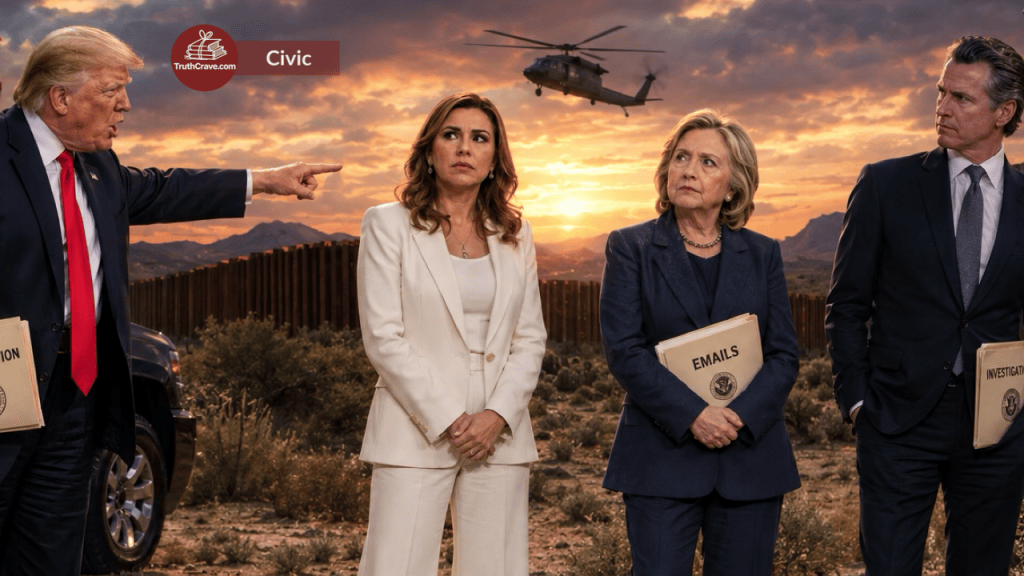
There is a powerful political technique that democracies should watch carefully: using the authority and visibility of government institutions to place political opponents under suspicion, allowing the resulting headlines to do the political work long before a court ever determines whether wrongdoing actually occurred. The issue is not whether governments should investigate politicians. Of course they should. Public officials are not above the law. The issue is what happens when an investigation—or even the announcement of an investigation—becomes a political event in itself. We have already seen how powerful this can be in the United States.
The Clinton example
In 2016, Hillary Clinton was already facing intense political scrutiny over her use of a private email system while serving as secretary of state. The FBI investigated the matter, and in July 2016 FBI Director James Comey announced that investigators had found evidence of extremely careless handling of classified information, but he recommended that the Justice Department not bring criminal charges. (FBI) Then, just days before the presidential election, Comey sent Congress a letter announcing that the FBI had discovered additional emails potentially relevant to the investigation. The timing was extraordinary.
The announcement immediately became a major national news story and revived the email controversy at the most consequential possible moment—when millions of Americans were making their final decisions about whom to support. Donald Trump won the Electoral College while Clinton won the national popular vote. The extent to which the FBI’s late intervention affected the result remains debated. But there is substantial evidence that the email controversy dominated coverage of Clinton and shaped voters’ perceptions of her. Research examining the 2016 information environment found that email-related news had a significant relationship with Clinton’s electoral prospects, while other analyses have specifically identified Comey’s late intervention as a potentially important factor. (Brookings)
That distinction matters. We cannot honestly say that the FBI announcement alone caused Clinton to lose. Elections are complicated, and numerous factors contributed to Trump’s victory. But the episode demonstrated something politically important: An official government announcement can generate a narrative powerful enough to influence an election even before prosecutors establish criminal wrongdoing. That is the technique worth remembering.
Now look south
Today, we are seeing a similar debate surrounding the Trump administration’s increasingly aggressive scrutiny of Mexican political figures. The Trump administration has targeted Mexican officials through visa restrictions, criminal investigations and federal indictments. ProPublica reported in 2025 that U.S. officials had identified a list of Mexican political figures suspected of connections to the drug trade, including members of Mexico’s governing Morena party and several governors. (ProPublica)
One of the most prominent cases involved Baja California Governor Marina del Pilar Ávila. In May 2025, Ávila announced that the United States had revoked her tourist visa as well as the visa of her then-husband, Carlos Torres Torres. The U.S. government did not publicly provide a detailed explanation, citing the confidentiality of visa cases. Torres said there was no formal accusation against them by U.S. or Mexican authorities at the time. (AP News)
That matters politically because the public does not experience a visa revocation as an abstract bureaucratic decision. It becomes a headline. And the headline can quickly become a political narrative:
Morena politician. U.S. government. Investigation. Cartels. Corruption.
The facts can become secondary to the association. There is an important complication, however. Subsequent events show why we have to distinguish between allegations, investigations and established facts. Mexican authorities later opened an investigation involving Torres, and the U.S. government subsequently brought criminal charges against Sinaloa Governor Rubén Rocha Moya and other Mexican officials in April 2026. Those U.S. allegations are serious, but an indictment is an accusation—not a conviction. (El País) That distinction is fundamental to democracy.
The presumption of innocence matters
A government does not need to convict someone in the court of public opinion in order to damage them politically. It only needs to create the association. Investigation. Cartel. Corruption. Morena. Drug trafficking. Repeat the association through official government announcements and media coverage, and eventually the accusation itself can become the story. That is where democratic institutions and voters need to be especially careful.
Every person accused of a crime is entitled to the presumption of innocence until proven guilty. An investigation is not a conviction. A visa cancellation is not a conviction. An indictment is not a conviction. An anonymous allegation is not a conviction. And government agencies have enormous credibility and communications power that ordinary political campaigns do not possess. When a U.S. federal agency makes an announcement about a Mexican politician, American media outlets report it. Mexican media outlets report it. Social media accounts repeat it. Political opponents repeat it. Within hours, an allegation can become an international political narrative.
From law enforcement to electoral politics
This is where the Mexico situation deserves scrutiny. Mexico’s governing party, Morena, currently holds enormous political power. U.S. pressure on Mexican politicians accused of connections to organized crime therefore has consequences beyond criminal law enforcement. It can also affect the reputation of Mexico’s governing political movement. That does not mean every investigation is politically motivated. It does not mean every allegation is false. And it does not mean that Mexican politicians should receive immunity from legitimate U.S. or Mexican investigations.
It means that the public should demand evidence before transforming government allegations into political conclusions. That standard should apply regardless of whether the politician is from Morena, PAN, PRI, the Democratic Party, the Republican Party or any other political organization. Because once government agencies become sources of politically explosive allegations, the media has a responsibility to distinguish between what officials allege and what has actually been established.
The media amplification problem
The danger becomes even greater when official allegations are immediately converted into sensational headlines. An American newspaper reports that a Mexican politician is being investigated. A Mexican television network repeats it. A political opponent describes the politician as corrupt. Social media accounts repeat the accusation without the qualification. Then another news organization cites the social-media discussion as evidence that the politician is facing a scandal. Suddenly, the original allegation has traveled through an entire information ecosystem while the underlying evidence may remain largely invisible to the public. The accusation becomes the evidence.
This is not how a healthy democratic information system should operate.
Journalism should ask:
What exactly has been alleged? Who is making the allegation? What evidence has been publicly presented? Has anyone been charged? Has anyone been convicted? What does the accused person say? What remains unproven? Those questions are especially important when the source of the allegation is the government of another country.
Mexico has the right to scrutinize American pressure
The right-wing ecosystem in the United States has an interest in removing Mexico’s left-wing Morena government from power. Its goal is to gain control over the country’s natural resources for the benefit of oligarchs and corporate interests. To achieve this, it is using propaganda to undermine Morena’s legitimacy and is increasingly framing Mexico’s cartel problems as national security threats to justify further military intervention, potentially undermining Mexican democracy and sovereignty in pursuit of hidden political and economic interests. Mexico has legitimate interests in defending its sovereignty and democratic institutions. Those interests are not mutually exclusive. But American law-enforcement power should not become a substitute for Mexican voters deciding whom they trust at the ballot box.
If the United States possesses evidence that a Mexican official committed a crime, the appropriate response is to present that evidence through legitimate legal channels and allow the justice system to operate. If evidence is insufficient to establish wrongdoing, the public should not be encouraged to treat suspicion as guilt. That is the line democratic societies should defend.
The lesson of 2016
The Clinton episode demonstrates why this matters. The FBI did not need to convict Clinton for the email controversy to become politically damaging. The investigation itself—and the government announcements surrounding it—became a central part of the election narrative. Years later, researchers continue to debate exactly how much those interventions affected the outcome. But the broader lesson is much easier to establish: official government information carries enormous political power, particularly when released at moments of maximum public attention. (Brookings)
That is why the standard must be higher than simply asking whether an investigation exists. We should ask what evidence supports it. We should ask why the information is being released when it is. We should ask how the media is presenting it. And we should remember that an accusation is not a conviction.
The United States should investigate genuine criminal activity wherever the evidence leads—including among foreign political officials. But accusations without evidence is just meddling in foreign elections plain and simple. The power of American government institutions should never become a mechanism for manufacturing political guilt before the facts have been established. Because once government authority, political competition and media amplification become intertwined, the battlefield is no longer just the courtroom. It becomes the mind of the voter. And that is precisely where democracy demands the greatest amount of skepticism.


Leave a Reply