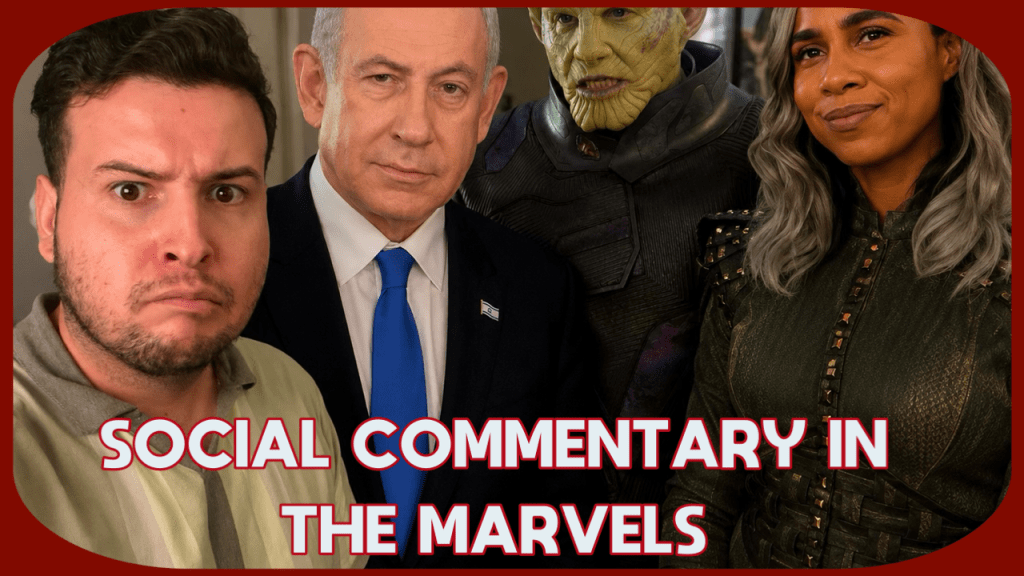
There is something I keep coming back to whenever I watch superhero movies: sometimes the aliens are not really the point.
They are a way of talking about us.
That was my reaction when I watched The Marvels. The conflict between the Kree and the Skrulls made me think about the conflicts we see in the real world—war, displacement, nationalism, political power, refugees, revenge and the consequences of governments making decisions that affect entire populations.
I posted my interpretation on Threads. Almost immediately, I was accused of being a bigot and an antisemite.
That reaction is what ultimately motivated me to make a reaction video.
I want to make something clear from the beginning: I am not arguing that Jewish people collectively hold extremist beliefs. I am not arguing that Jewish people are responsible for the actions of the Israeli government. And I am not arguing that Jewish people all share the same political beliefs.
They obviously don’t.
Jewish communities, like every other community, contain enormous political and religious diversity.
My argument is about something different: we should be able to criticize governments, political movements and religious extremism regardless of who is involved.
And if we’re serious about that principle, we have to acknowledge that Jewish extremism exists just as Christian, Muslim, white-nationalist and other forms of extremism exist.
The examples are not imaginary
This is where I think the conversation needs to become more specific.
There are documented examples of Israeli political and religious figures making deeply dehumanizing or extremist statements about Palestinians.
In 2013, Israeli religious-nationalist politician Rabbi Eli Ben-Dahan described Palestinians as not being human and compared them to animals. He later became Israel’s deputy defense minister, with responsibilities that included the Civil Administration governing the occupied West Bank.
In 2024, Rabbi Eliyahu Mali, head of the Shirat Moshe religious school in Jaffa, made statements advocating that Gazans—including women and children—could be killed, invoking religious concepts concerning holy war.
And this isn’t merely a discussion about obscure figures on the internet.
In August 2026, Israel’s National Security Minister Itamar Ben-Gvir publicly advocated killing 30 to 40 people in Gaza every night, including people who did not pose an immediate threat, and has repeatedly promoted extremely hard-line policies toward Palestinians.
These examples don’t prove anything about Jewish people as a whole.
They prove something much narrower—and much more important:
Jewish religious and political extremism exists, and some people holding those views have occupied positions of significant influence.
That should be possible to say without turning the statement into an accusation against an entire ethnic or religious population.
Netanyahu and the memory of Rome
There is another example that deserves serious discussion.
In 2025, Benjamin Netanyahu was asked what he was reading. He identified Barry Strauss’s Jews vs. Rome: Two Centuries of Rebellion Against the World’s Mightiest Empire, a historical account of the Jewish revolts against Rome.
The journalist then asked Netanyahu what made him pick up the book.
Netanyahu’s response was striking:

“Well, we lost that one. I think we have to win the next.” (Radbod’s Lament)
That statement deserves scrutiny.
I am not claiming that Strauss’s book itself is extremist. It is a work of history examining centuries of conflict between Jews and Rome.
What interests me is Netanyahu’s framing of that history.
“We lost that one.”
“We have to win the next.”
Who is the “we”?
What is the “next”?
And what does Netanyahu believe constitutes the modern equivalent of Rome?
Those are legitimate questions for journalists and citizens to ask, particularly when the person making the statement is the prime minister of Israel.
There are people who interpret “Rome” in this context as a metaphor for the Western world, while others interpret Netanyahu’s comment more narrowly as a reference to Israel’s contemporary struggle against hostile powers or existential threats. The statement itself does not establish which interpretation is correct.
But that uncertainty is precisely why the comment deserves examination rather than dismissal.
We should be able to ask what historical analogies political leaders are drawing upon.
We should be able to ask how ancient conflicts are being used to understand modern conflicts.
And we should be able to question what leaders mean when they describe an ancient defeat and then say, “we have to win the next.”
That isn’t an attack on Jewish people.
It’s political analysis of a statement made by a political leader.
Netanyahu and Amalek
There is another example that makes the discussion even more complicated.
In October 2023, Netanyahu invoked the biblical story of Amalek while addressing Israeli soldiers during the war in Gaza.
The reference became controversial because of the biblical command concerning Amalek and the way that passage has been interpreted in discussions of the conflict.
Again, I don’t think the responsible response is to conclude that every Jewish person shares the beliefs associated with that biblical story.
But I also don’t think the responsible response is to pretend that religious language has no political significance when political leaders use it during wartime.
We should examine what leaders say.
We should examine the historical context.
We should examine how their words are interpreted.
And then we should debate the evidence.
That’s what political discussion is supposed to be.
Fiction has always reflected reality
This brings me back to The Marvels.
I don’t buy the idea that movies exist completely outside politics and society.
Artists live in the same world we do. Writers, directors and actors absorb the events happening around them. Sometimes political themes are intentional. Sometimes they’re subconscious. Sometimes audiences see connections the creators never intended.
That’s part of the point of art.
People have interpreted Star Wars through ideas about empire and authoritarianism.
The X-Men franchise has frequently been discussed through themes of discrimination and political persecution.
Science fiction has spent decades asking questions about refugees, colonialism, war, artificial intelligence and what happens when one group decides another group is less deserving of rights.
So when I watched The Marvels and saw the Kree-Skrull conflict, I didn’t think it was unreasonable to think about contemporary conflicts.
Maybe someone else watches the same movie and sees nothing political.
That’s fine.
But my interpretation isn’t automatically illegitimate because someone else doesn’t share it.
Interpretation is not accusation
This is the distinction I wish we could make more often.
Seeing political symbolism in a fictional story does not mean accusing every member of a particular group of secretly supporting the politics represented in that story.
Those are two completely different things.
When I look at a fictional conflict and think about Israel and Palestine, or refugees and nationalism, that doesn’t mean I believe every Israeli person thinks alike.
It doesn’t mean I believe every Jewish person supports the Israeli government.
It doesn’t mean I believe Jewish people collectively share a particular ideology.
In fact, the existence of Jewish critics of Israeli government policy and Jewish opponents of Zionism demonstrates precisely why collective blame makes no sense.
But acknowledging that diversity shouldn’t mean becoming afraid to discuss political extremism when it exists.
We cannot fight extremism selectively
One of the reasons I started thinking more seriously about radicalization was because I realized how much of my own understanding of the world had been shaped by things I simply assumed were true.
There were things I initially dismissed as conspiracy theories.
Then I started researching for myself.
Sometimes I discovered that the original claim was exaggerated or wrong.
Other times, I discovered that there was a real historical or political issue underneath the sensationalized version.
That taught me something important:
Don’t blindly believe the internet—but don’t blindly dismiss it either. Research it.
If somebody makes a claim about an extremist movement, investigate the claim.
Look at the history.
Look at primary sources.
Look at credible reporting.
Look at what the people involved actually said.
Then decide whether the claim holds up.
And if it doesn’t, say so.
But if it does, we shouldn’t pretend it doesn’t exist simply because discussing it makes people uncomfortable.
That applies to every religion and every political ideology.
Criticism should move upward, not outward
There is another distinction that matters enormously.
There is a difference between criticizing a government and blaming a people.
There is a difference between criticizing a political ideology and attacking the people associated with that identity.
There is a difference between criticizing Jewish extremism and attacking Jews.
There is a difference between criticizing Islamist extremism and attacking Muslims.
There is a difference between criticizing Christian nationalism and attacking Christians.
Those distinctions aren’t technicalities.
They’re the difference between political criticism and bigotry.
If I believe a government is committing atrocities, I should be able to say that.
If I believe a political ideology is dangerous, I should be able to argue that.
If I believe an extremist religious movement is dangerous, I should be able to criticize it.
But I should also be willing to apply the same standard to my own political side.
That’s what consistency looks like.
Criticize the Israeli government without blaming Jews.
Criticize Hamas without blaming Palestinians or Muslims.
Criticize Christian nationalism without blaming Christians.
Criticize Islamist extremism without blaming Muslims.
Criticize Jewish extremism without blaming Jewish people.
Being called offensive isn’t the end of the conversation
Some people told me that my interpretation of The Marvels was offensive.
They’re allowed to think that.
They’re allowed to call my interpretation wrong.
They’re even allowed to call me a bigot if that’s genuinely what they believe.
What I don’t accept is the idea that calling something offensive should automatically end the conversation.
Sometimes art is supposed to make us uncomfortable.
Sometimes political discussion is supposed to make us uncomfortable.
Sometimes somebody says something we strongly disagree with, and the appropriate response isn’t censorship or name-calling.
It’s an argument.
Tell me where I’m wrong.
Show me the evidence.
Explain why my interpretation doesn’t work.
Give me another interpretation.
That’s how people actually learn.
And I’m willing to do the same.
If somebody presents evidence that changes my understanding, I’ll reconsider my position.
I don’t think changing your mind after learning something new is weakness.
I think it’s intellectual honesty.
So what did I see in The Marvels?
I saw a fictional story about groups fighting over resources, territory, power and survival.
I saw refugees searching for somewhere to live.
I saw the consequences of political decisions.
I saw people who had suffered and people who wanted revenge.
And I saw a superhero movie doing something science fiction has always done: giving us fictional worlds through which we can think about our own.
Maybe that wasn’t the intention of every person involved in making the movie.
Maybe another viewer sees something completely different.
That’s the beauty of fiction.
We don’t have to receive the same message.
We don’t even have to agree about what the message is.
But we should be able to talk about it.
And if my interpretation makes you uncomfortable, I’d rather you tell me why than tell me that I’m not allowed to have the interpretation at all.
Because the answer to uncomfortable ideas shouldn’t always be silence.
Sometimes the answer should be a conversation.
That’s the conversation I’m trying to start.


Leave a Reply