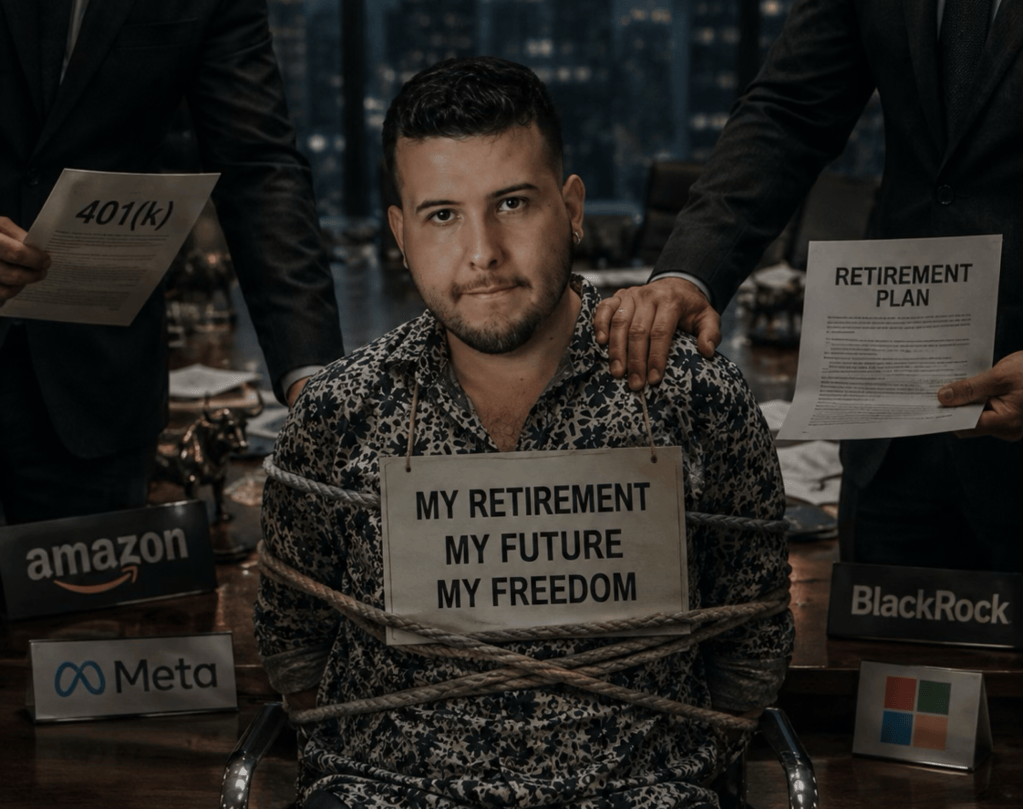
Pensions disappeared. Social Security remains under political attack by Republicans. Now millions of Americans are expected to gamble their futures on the stock market. For younger generations, the question is becoming impossible to ignore: What exactly are we supposed to do to plan for our future?
By Jonathan Marquez
For decades, Americans have been told to prepare for retirement. Work hard. Save money. Invest responsibly. Put money into a 401(k). Trust the market to grow over time. That promise is increasingly difficult to believe now. Traditional pensions have largely disappeared from the private sector, replaced by defined-contribution retirement plans that shift much of the responsibility and risk from employers onto workers. Social Security, meanwhile, has become a perpetual political battleground. And now, the financial markets that millions of Americans depend on for retirement are becoming increasingly concentrated, speculative, and intertwined with corporations whose personal interest might not benefit society or democracy. So where does that leave younger generations? We’re being asked to build a future using financial tools we are increasingly being given reasons to distrust.
From Pensions to Market Pensions and Potential Extortion
There was a fundamental shift in the American social contract. A pension promised workers something relatively simple: work for years, and in return, you would receive a predictable income in retirement. The 401(k) changed that equation. Instead of guaranteeing retirement income, employers increasingly placed the responsibility on workers to save and invest successfully. Workers were expected to become amateur investors, navigating stock markets, economic crashes, inflation, corporate failures, and financial speculation all while simply trying to avoid poverty in old age. We normalized the idea that ordinary people should tie their futures to Wall Street. we sucked it up.
And perhaps that system made more sense when markets were perceived as relatively stable engines of long-term economic growth. But what happens when increasing portions of the market appear driven by speculation, hype, and its being manipulated by people with extraordinary concentration of wealth and corporate power?
What happens when the companies dominating investment portfolios are no longer simply selling products but are actively shaping politics, public policy, media, technology, and even attacking democratic institutions? The question is no longer simply whether your retirement investments will grow. We also have to ask: What are we investing in, and what does that investment compel us to tolerate? Is the corporation holding my retirement money capable of using my own financial dependence against me? Does that corporation actually have my best interests at heart? And what happens when speaking out against a corporation, protesting it, or demanding accountability could potentially hurt the value of the very investments we’re relying on for our future? Under an increasingly radical form of capitalism, where corporate profit and power are often prioritized above the public interest, we can no longer automatically assume that the answer benefits us.
The Danger of Turning Retirement Into a Casino
The greatest concern is not that investing is inherently bad. Long-term investing can be an important tool for building wealth. The problem is pretending that financial markets are incapable of failure or that ordinary people face the same risks as the wealthy insiders who help shape those markets. History tells us otherwise. Financial bubbles are created. Markets crash. And when they do, wealthy investors often have political connections that that save them with public funds and regular people do not get the help. The people most vulnerable are those who cannot afford to lose and they let their lives get ruined. Someone with billions of dollars can survive a market crash. Someone planning for retirement who loses a substantial portion of their life savings may not recover.
And if an AI-driven speculative bubble bursts—after being inflated by massive investments, extraordinary valuations, and companies repeatedly promising technologies and profits that may not materialize—we should be asking now, not afterward, who will pay the price.
Consider the concerns surrounding Elon Musk’s potential SpaceX IPO. The danger isn’t simply whether SpaceX succeeds or fails. The larger issue is what happens when highly speculative companies with enormous valuations become deeply embedded in the financial system. When major indexes add companies to their benchmarks, index funds, pension funds, and retirement accounts that track those indexes can end up purchasing those stocks automatically.
That means ordinary Americans may find their retirement savings exposed to corporations and speculative valuations they never individually chose to invest in. If a company is dramatically overvalued and its stock eventually collapses, wealthy insiders who entered early may have opportunities to protect themselves or cash out. But the people whose retirement accounts gained exposure through broad market and index funds could be left absorbing the consequences.
That is what makes the current moment particularly concerning. A speculative bubble doesn’t have to convince every American to personally gamble on it. If speculative companies become large enough and powerful enough within major indexes, millions of workers can become financially exposed simply by doing what they were told was responsible: saving for retirement. And if that bubble bursts, we should be asking now not afterward who will pay the price. Sellout Corporate elected officials will protects corporations and oligarchs while ordinary Americans watch their retirement savings disappear? or even used as leveraged to discourage protest. We have seen versions of this story before.
Economic Desperation Creates Political Extremism
There is another consequence that deserves far more attention. Economic insecurity is not just an economic problem. It becomes a political problem. When communities lose jobs, industries disappear, and people feel abandoned, they become vulnerable to demagogues offering simple explanations for complicated problems. Instead of confronting corporate consolidation, automation, inequality, or failed economic policy, people are often encouraged to blame immigrants, minorities, foreign countries, or whichever political enemy is most convenient.
We have already watched this happen in America in the last 15-20 years. Rural Communities devastated by economic automation of warehouses were promised scapegoats instead of solutions. Trump’s Far Right Political movements exploited legitimate economic anxiety and redirected it toward racial and cultural resentment.
Now we are entering another era of economic uncertainty. Automation transformed industries and eliminated jobs. Artificial intelligence threatens to create another wave of disruption, potentially affecting not only factory workers but office workers, artists, writers, programmers, customer service employees, and countless others. What happens when millions more people feel economically disposable? And more importantly, what happens if political leaders continue to refuse to address the radical capitalist extremist causes of economic insecurity? We should not underestimate the danger. A society that repeatedly creates economic instability while refusing to provide economic security creates ideal conditions for extremism.
Radical Capitalism Is Not Freedom
Radical Capitalist Extremis is often propagandized as synonymous with freedom in The USA. But there is nothing inherently liberating about an economic system that demands endless growth regardless of social consequences. When corporations eliminate jobs simply because they can increase profits, while society provides no adequate safety net for displaced workers, that is not necessarily innovation serving humanity. When social security and other social services are defunded because austerity is considered more important than human wellbeing, that is not necessarily economic responsibility.
When ordinary people are expected to gamble their retirement savings on increasingly complex financial markets while billionaires and corporations extract unprecedented wealth, we should question whether the system is still serving the public or slaving it. At some point, capitalism can become radical. And radical extremist capitalism is just as dangerous as any other ideology when it becomes incapable of recognizing limits. An economic system should exist to serve society. Society should not exist merely to be slaved to the economic system while receiving no substantial value in return.
So What Are We Supposed to Do?
This is the question I keep coming back to. What are young people supposed to do? We are watching Social Security being attacked by radical capitalist extremist. Pensions are increasingly rare. Owning a House is unaffordable in much of the country. Wages have failed to keep pace with the cost of living. Artificial intelligence threatens future employment. And the primary solution offered to younger generations is still the same:
Put your money into the shady market, hope everything works out and ignore the clear hostage situation.
That is not a serious long-term social policy for young people. Individuals should absolutely educate themselves about personal finance, diversify when possible, save responsibly, and avoid making reckless decisions based on fear. But individual financial discipline cannot solve a systemic failure and traps being built by sell out elected officials and corporations. We cannot tell an entire generation to simply “invest better” while refusing to address the structural corruption surrounding them.
Young Americans need to start seriously discussing what retirement should look like in the twenty-first century. We need stronger retirement protections. We need to protect and strengthen Social Security. We need to explore new forms of universal retirement security. We need greater transparency and accountability in financial markets.
We also need to know whether the corporations where our money is being invested actually have the best interests of society at heart. Why is our future being invested in corporations that may actively undermine democratic institutions? And how could these powerful entities use our own financial investments—and our dependence on them—against us? We need to ask whether it is acceptable for an entire population’s future to depend so heavily on the continued success of corporations whose interests may fundamentally conflict with the public good.
Because right now, millions of Americans are being asked to place their futures into a system they have little control over. And perhaps the most disturbing part is that we have been taught to call this freedom. The conversation about retirement cannot wait until another economic collapse forces us to have it—or until corporations with anti-democratic ambitions become so powerful that they can use our own retirement investments and financial dependence against us. By then, it may already be too late.
Perhaps the greatest danger isn’t simply losing our retirement savings in the next market crash. Perhaps it’s building an entire generation’s future around corporations so powerful that challenging them could eventually mean threatening our own financial security.
That is not freedom.
By Jonathan Marquez and Duck.ai
Watch my Video Reaction.
 Truth Crave
Leave a comment