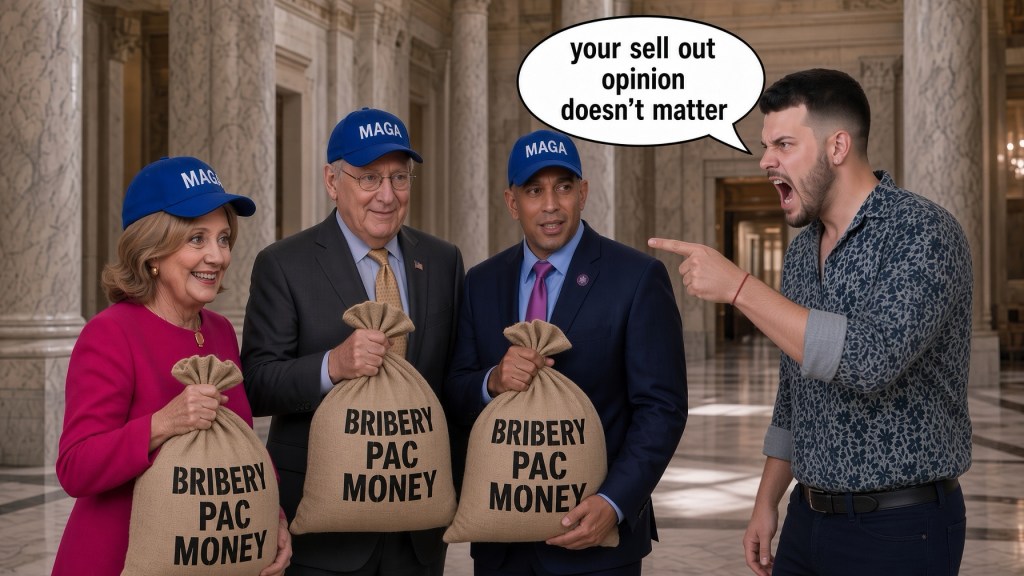
There are moments in history when a nation must honestly ask itself who its government serves.
Watching Congress today, I find myself increasingly disappointed by what appears to be a bipartisan culture of dependency on special-interest money, foreign-policy lobbying organizations, and wealthy donors whose priorities often seem disconnected from those of ordinary Americans.
Whether the issue is healthcare, housing, wages, infrastructure, or education, Americans are repeatedly told there is never enough money, never enough political will, and never enough urgency. Yet when foreign-policy priorities are involved, many elected officials suddenly discover limitless determination.
That contradiction has become impossible to ignore.
For decades, members of both the Republican and Democratic parties have accepted campaign contributions from donors and political action committees that advocate strongly for specific foreign-policy interests, including organizations and donors aligned with pro Israel money. These contributions are legal under current American law. Yet legality and ethics are not always the same thing.
The fundamental question is simple: who does elected officials prioritize?
The citizens who sent them to Washington?
Or the interests of foreign and corporate donor networks who buy influence by financing their campaigns?
Many Americans increasingly believe the answer is obvious from the behavior they witness.
Criticism of this system is frequently dismissed as extremism or conspiracy, but the reality is far more mundane. The influence buying corruption industry operates largely in the open. Campaign contributions, lobbying expenditures, political action committees, and donor networks all help shape policy outcomes. That is not a secret. It is how the sell out system currently functions.
The problem is that influence can become dependency.
And dependency can become corruption.
I do not use the word corruption lightly. Corruption does not require a briefcase full of cash exchanged in a dark alley. Corruption can occur when public officials become more responsive to major donors than to voters. It can occur when political careers become dependent on maintaining the approval of powerful interests rather than representing the people who elected them.
That concern becomes especially serious when the issue involves foreign governments.
No foreign nation—whether Israel, Saudi Arabia, China, Russia, Qatar, or any other country—should possess disproportionate influence over American policymaking. This is corruption even if currently legal.
The United States is supposed to be a sovereign republic.
The United States government exists to serve Americans.
Yet many citizens increasingly feel that questioning foreign-policy orthodoxy is treated as more offensive in Washington than questioning whether Americans can afford rent, healthcare, or food.
That perception damages trust.
It also creates growing concern about efforts to deepen military, intelligence, and strategic integration with foreign governments without sufficient public debate or democratic accountability.
Regardless of where one stands on Israel, Americans have a right to question whether their sell out government is becoming too closely aligned with the policies of apartheid nation such as Israel.
They have a right to ask whether future generations are being locked into commitments they never consented to.
They have a right to demand transparency regarding lobbying, campaign financing, military agreements, intelligence cooperation, and foreign influence.
These questions become even more urgent because Israel itself is not beyond criticism.
Organizations such as Amnesty International, Human Rights Watch, and various United Nations bodies have raised serious proven allegations regarding discrimination, unequal legal treatment, settlement policies, and violations of international law in the Israeli-Palestinian conflict.
In a democracy, Americans should be free to discuss those issues without being accused of disloyalty.
What concerns me most is not simply the influence of one foreign government.
It is the broader precedent.
If elected officials can become financially dependent on interests connected to foreign-policy agendas today, what prevents future governments from expanding that influence tomorrow?
What happens when citizens attempt to reform the system?
What happens when future generations decide they want stricter lobbying laws, public campaign financing, or greater independence from foreign influence?
Will they discover that previous politicians spent decades embedding those relationships into institutions that are difficult to change? Will future generations find out that corrupt sell out politicians sold their country to xenophobic foreign governments who see them as slaves?
History will ultimately judge whether today’s leaders acted as representatives of the American people or whores/prostitutes of a political system increasingly shaped by foreign money and corporate influence.
As a patriot citizen, I hope future generations inherit a government that answers first to its voters.
As an observer of current events, I worry they may instead inherit a government that spent decades selling pieces of its independence to whoever could afford the highest bid.
That possibility should concern every American, regardless of political party, religion, or position on Israel.
Because the question at stake is bigger than any one country.
It is whether the United States still belongs to its citizens or if corrupt sell out politicians controlled by foreign governments gave their country away.
By Jonathan Marq


Leave a Reply