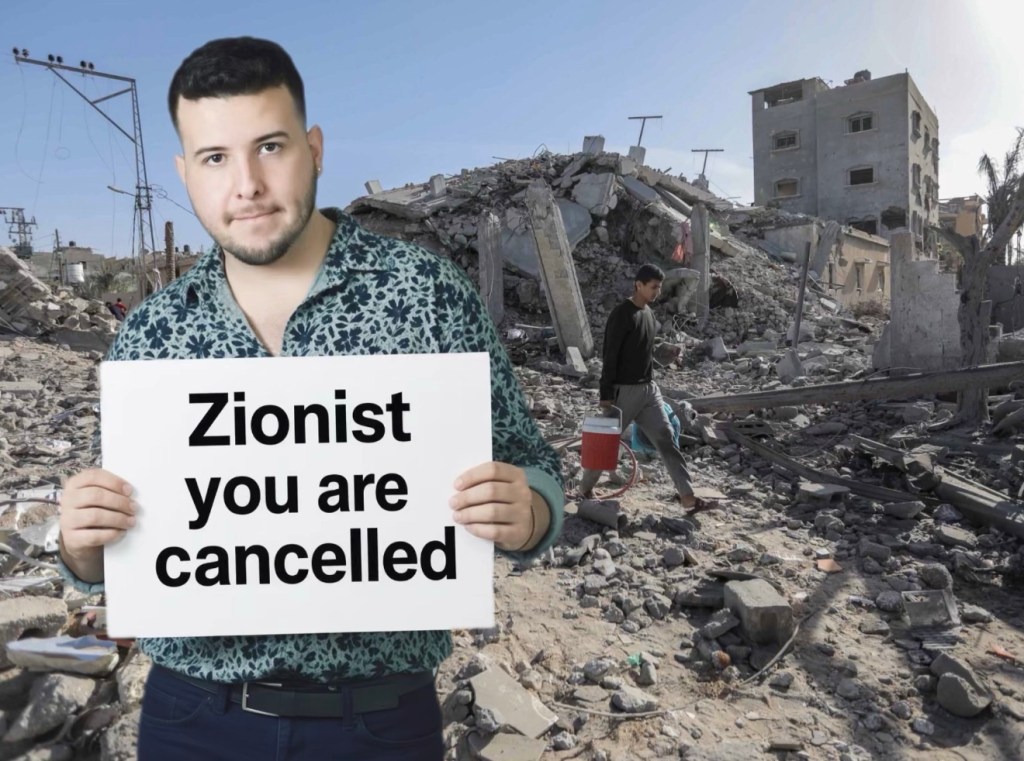
I want to share why I became openly opposed to the Israeli government’s actions—and why I have become increasingly hostile toward American politicians who put unconditional support for Israel ahead of accountability—it is actually very simple:
I stopped supporting what Israel’s government was doing.
That is not an act of hatred toward Jewish people. It is not an attack on Judaism. For me, it is an expression of democracy. I live in a country where citizens are supposed to have the right to look at what their government is doing, decide that they believe it is wrong, and organize politically to stop it.
If my government sends weapons, money, diplomatic support, or political protection to a foreign government whose conduct I believe is contributing to catastrophic suffering in Gaza, I have every right to object. And I have the right to be angry about it.
The International Court of Justice found that some of the rights asserted by Palestinians under the Genocide Convention were plausible and ordered provisional measures concerning the protection of Palestinians and humanitarian assistance.
That alone should tell us that these are not frivolous questions.
Americans should be allowed to debate them.
And politicians who support these policies should expect political consequences.
We should be allowed to protest them.
We should be allowed to condemn them.
That is what democratic accountability looks like.
Political criticism is not antisemitism
There is an increasingly dangerous tendency in American politics pushed by the Israel lobby to treat criticism of Israel as inherently suspicious and criticism of pro-Israel politicians as evidence of antisemitism.
That is an enormous mistake an a clear attack on the first amendment.
Antisemitism is real and it should be confronted.
But opposing the policies of the Israeli government is not inherently antisemitic.
Neither is opposing American military aid to Israel.
Neither is arguing that Palestinian civilians deserve equal human rights.
Neither is arguing that Israel should face consequences for alleged violations of international law.
And neither is voting against politicians because of their foreign-policy positions.
At the same time, we should not pretend that every person involved in Israeli politics is acting in good faith or that extremist ideology does not exist within Israeli society.
It does.
And there is documented evidence of Jewish religious and political figures in Israel expressing deeply racist, dehumanizing, and extremist views toward Palestinians and other non-Jews.

Rabbi Eli Ben-Dahan, for example, said in a 2013 interview that Palestinians were “like animals” and “aren’t human.” He later became Israel’s deputy defense minister, giving his views considerably more political significance than those of an ordinary private citizen. (The Times of Israel)
There are other examples.

Israeli political and religious movements associated with Kahanism have advocated ethnic separation, expulsion of Palestinians, and Jewish supremacy. Kahanist politician Itamar Ben-Gvir eventually became Israel’s national security minister and has continued to advocate extremely aggressive policies toward Palestinians. (The Guardian)

And in August 2026, Ben-Gvir publicly advocated killing dozens of people in Gaza every night and argued for Israeli settlement throughout the territory while supporting Palestinian emigration. (AP News)
These are not claims that Jews as a people are radical.
They are documented examples of specific people and political movements holding radical positions.
That distinction is essential.
Religious extremism deserves criticism too
There are also documented examples of religious leaders using theology to justify the dehumanization or destruction of Palestinians.

A 2026 legal submission by Adalah, for example, documented statements by Rabbi Eliyahu Mali instructing students that no one in Gaza should be left alive, including women and children. (ILC Pal)

And Netanyahu himself invoked the biblical story of Amalek in a November 2023 message to Israeli soldiers. That reference has generated enormous controversy because the biblical account describes the destruction of Amalek, including women and children. A congressional resolution later cited Netanyahu’s statement alongside similar rhetoric from other Israeli officials. (GovInfo)
Another example deserves scrutiny. In 2025, Benjamin Netanyahu was publicly asked about the book he was reading, Jews vs. Rome: Two Centuries of Rebellion Against the World’s Most Powerful Empire, by historian Barry Strauss. Netanyahu explained his interest by saying, “We lost that one, I think we have to win the next one.” (Radbod’s Lament) This demonstrate that Israel’s prime minister is consciously interpreting contemporary political and military struggles through the historical memory of Jewish conflict with Rome. When that historical framework is combined with statements invoking Amalek, rhetoric about revenge, and extremist political movements advocating the expulsion or destruction of Palestinians, Americans have every right to ask what kind of political ideology is influencing the leadership of an important U.S. ally. (Sunna Files Website) Criticizing that ideology is not an attack on Jewish people. It is precisely what we should do with any political movement—Jewish, Christian, Muslim, secular, Israeli, American, or otherwise—that begins turning ancient grievances into justification for present-day violence. The existence of Jewish extremists does not make Jews collectively responsible for their actions, just as the existence of Christian or Muslim extremists does not make every Christian or Muslim responsible for theirs. But neither should anyone receive immunity from political scrutiny because of their religious identity.
People are entitled to debate what Netanyahu intended by that reference.
But they are also entitled to criticize it.
They are entitled to ask whether religious language about destroying an ancient enemy is appropriate when discussing a contemporary civilian population.
They are entitled to criticize politicians who invoke religious narratives while directing a modern military campaign.
And they are entitled to oppose religious extremism when it enters government.
That is not anti-Jewish.
It is opposition to extremism.
Radicalism does not become immune from criticism because of someone’s religion
This is the part of the conversation that I think Americans need to be intellectually honest about.
If a Christian politician uses Christianity to justify oppression, I should be allowed to criticize Christian extremism.
If a Muslim politician uses Islam to justify oppression, I should be allowed to criticize Islamic extremism.
If a Jewish politician uses Judaism to justify oppression, I should be allowed to criticize Jewish extremism.
The standard has to be the same.
The answer cannot be that criticism suddenly becomes bigotry because the extremist happens to belong to a particular religion.
We should judge people by what they actually say, do, support, or advocate—not by the religious or ethnic group into which they were born.
You don’t get to demand immunity from criticism or make it illegal because it hurts your feelings
There is another uncomfortable truth that Americans need to accept:
If you publicly support a controversial government policy, people are allowed to criticize you for supporting it.
They can call your politics immoral.
They can accuse you of enabling suffering.
They can organize against you.
They can vote against you.
They can protest outside your office.
They can demand that you resign.
They can make you politically uncomfortable.
They can call you name and write you mean tweets.
That is fundamentally different from threatening someone with violence or targeting them because they are Jewish.
We should be able to draw that distinction without difficulty.
The answer to political criticism cannot simply be, “That makes me uncomfortable, therefore it is hate.”
Sometimes discomfort is the unavoidable consequence of being challenged.
Sometimes anger is the unavoidable consequence of confronting what people believe is injustice.
And sometimes political movements lose support precisely because people become uncomfortable with what those movements are defending.
That is democracy. You are not entitled to our government and the taxes of people.
The First Amendment does not exist to protect comfortable speech
This is where I become particularly concerned about efforts to turn political definitions of antisemitism into legal restrictions on expression.
The First Amendment exists precisely because governments cannot be trusted to decide which political ideas citizens are permitted to express.
That does not mean every statement is protected from consequences. Threats, harassment, and violence are different matters.
But the government should be extremely cautious about creating legal definitions that blur the line between hatred of Jews and criticism of a foreign government, a political ideology, a military campaign, or American foreign policy.
Because once the government gets the power to define political criticism as forbidden expression, that power does not magically remain limited to one political cause.
It can be used against everyone.
Today it may be used against someone criticizing Israel.
Tomorrow it could be used against someone criticizing Saudi Arabia, China, Russia, India, or corporations or undemocratic capitalism. Or whom ever bought and paid for the politician.
The principle has to be bigger than the politics of the moment.
Americans have the right to change their minds
I don’t think people should be required to maintain political loyalties forever.
I once had a different view. I even called my self a Zionist.
Then I watched events unfold.
I learned more.
I became more critical.
And eventually I changed my mind.
That is allowed.
Americans are allowed to become anti-war.
They are allowed to become anti-interventionist.
They are allowed to oppose military aid.
They are allowed to oppose the Israeli government’s policies.
They are allowed to oppose American politicians who support those policies.
And they are allowed to organize politically to change American foreign policy.
None of that should automatically be treated as evidence of antisemitism or anti American terrorism.
If there is genuine antisemitism, confront it directly.
If there is genuine hatred of Jews, condemn it.
If someone threatens Jewish people with violence, prosecute that conduct according to the law.
But don’t take legitimate political opposition and place it inside the same category simply because it makes powerful people uncomfortable.
Because democratic accountability is supposed to make powerful people and in this case Zionist jewish people uncomfortable.
That is the point.
A government should not be protected from criticism because criticism is unpleasant.
A politician should not be protected from consequences because their foreign-policy position is controversial.
And no foreign government should receive a permanent exemption from scrutiny simply because Americans have been propagandized that questioning its policies is somehow beyond the boundaries of respectable political debate.
I became opposed to Israel’s government’s actions because I stopped believing those actions deserved my support.
I reserve the right to say so.
I reserve the right to organize around that belief.
I reserve the right to demand that my government change its policy.
And I reserve the right to vote accordingly.
That’s not antisemitism.
That’s democracy.
By Jonathan Marquez and Duck.ai


Leave a Reply