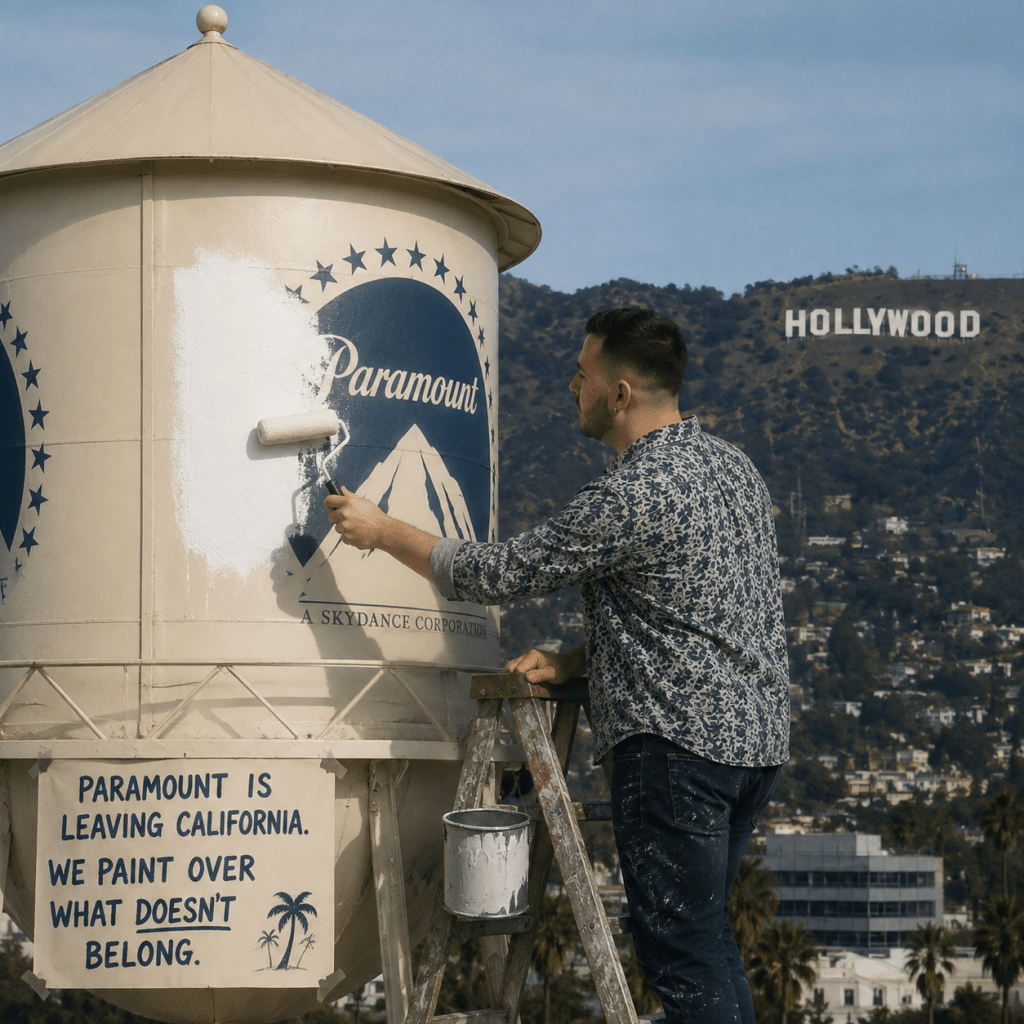
There is something almost poetic about Paramount leaving California.
Not because the loss of jobs is something to celebrate. It isn’t. Losing production jobs, tax revenue, and an iconic Hollywood institution hurts California. Paramount has been part of the state’s cultural and economic identity for generations.
But maybe we should stop looking at Paramount’s departure only as an ending.
Maybe it is an opening.
Maybe it is time to ask a much bigger question:
Who is going to be the next Paramount?
California has spent a century building the world’s greatest entertainment industry. Some of the most influential media institutions in American history were born here. But many of those institutions no longer resemble the companies generations of Americans grew up trusting.
The Washington Post was once synonymous with serious journalism and institutional credibility. Paramount became synonymous with Hollywood itself. These were not merely corporations. They were cultural institutions.
And then ownership changed.
The institutions remained. The buildings remained. The logos remained.
But something about the relationship between the institutions and the public changed.
Jeff Bezos’ ownership of The Washington Post has increasingly turned the paper into a lightning rod for arguments about billionaire ownership and editorial independence. Paramount, meanwhile, is entering another chapter under the Ellison family, as its future becomes increasingly intertwined with the politics and business interests of its new owners.
This is bigger than Paramount.
It is about what happens when billionaires inherit institutions that were built over generations.
The far right spent decades complaining that mainstream media would never give them a seat at the table. Instead of building competing institutions capable of reaching the top, some of the most powerful people on the right have increasingly pursued ownership of existing institutions.
But there is a problem with buying a legacy.
You can buy the company without inheriting the trust.
You can buy the newspaper without inheriting its credibility.
You can buy the studio without inheriting Hollywood’s cultural legitimacy.
You can buy the network without inheriting the audience’s affection.
And once that trust disappears, the logo cannot save you.
That is why I am not convinced that Paramount leaving California has to be the catastrophe some people assume it will be.
Yes, California should fight to protect workers. Yes, policymakers should do everything possible to keep production, create good-paying entertainment jobs, and maintain the infrastructure that makes Hollywood possible.
But California should also think beyond Paramount.
What if the next generation of entertainment companies is waiting to be built?
The history of American capitalism is filled with companies that once seemed impossible to replace. Then somebody built something new.
That is how industries evolve.
The mistake would be assuming that because Paramount is leaving, California’s best days in entertainment are behind it.
They aren’t.
California has universities. Artists. Writers. Directors. Actors. Editors. Animators. Musicians. Engineers. Designers. Entrepreneurs. Independent filmmakers. Technologists. And millions of people who still want to tell stories.
What California needs is not nostalgia.
It needs investment.
Invest in new studios.
Invest in independent production companies.
Invest in animation.
Invest in virtual production.
Invest in streaming technology.
Invest in local journalism.
Invest in new newspapers and digital publications.
Invest in creators who don’t have billionaires behind them.
And most importantly, give new companies a chance to become institutions.
Because perhaps we have spent too much time trying to preserve yesterday’s media giants instead of helping build tomorrow’s.
There is also a lesson here about political power.
Elon Musk’s relationship with California demonstrated how quickly a billionaire can turn a political and cultural dispute with the state into a corporate migration story. Musk moved major operations toward states friendlier to his politics, while his companies continued to benefit from enormous government relationships and contracts.
But government contracts cannot be the permanent business model for every politically connected billionaire.
There are limits to how much government can subsidize private power.
And there are limits to how much the public will tolerate.
Companies can leave California.
They can move headquarters.
They can move studios.
They can move executives.
But they cannot simply move their reputation.
There are social consequences to corporate decisions.
People decide what to watch.
People decide what to subscribe to.
People decide which publications they trust.
People decide which brands deserve their attention.
And yes, Americans have become remarkably good at canceling people and companies they believe have crossed a line.
You cannot manufacture public loyalty with a corporate relocation strategy.
You cannot force people to love a brand because a billionaire owns it.
And you cannot assume that a legacy built over 100 years will automatically survive another 100 years under completely different leadership.
That is the opportunity California should seize.
Instead of desperately begging every legacy company to stay forever, California should make itself the easiest place in America to build the next generation of media companies.
Let Paramount go if it insists on going.
And then let’s build something new.
Let’s build studios that belong to a new generation.
Let’s build media companies that don’t depend on billionaires turning journalism into personal megaphones.
Let’s build entertainment companies that understand their audiences instead of treating them as assets on a balance sheet.
Let’s build institutions that can earn trust instead of inheriting it.
Maybe Paramount leaving California will cost us something.
But perhaps it will also create space.
Space for another studio.
Space for another newspaper.
Space for another network.
Space for another media giant that hasn’t been corrupted by decades of corporate consolidation.
The Washington Post was once new.
Paramount was once new.
Every institution we now consider legendary was once somebody’s crazy idea.
So instead of asking whether California can survive without Paramount, perhaps we should ask something more ambitious:
Who will become the next Paramount?
Who will build the next Washington Post?
Who will create the next great American media institution?
Who will make the movies, produce the journalism, build the studios and tell the stories that define the next century?
That future isn’t owned yet.
And that’s the exciting part.
Bye-bye, Paramount.
California has lost companies before.
It has also created them.
So let’s stop worshiping the legacy companies that no longer resemble the institutions we once loved.
Let’s build new ones.
The next generation is here.
Who’s next?
 Truth Crave
Leave a comment