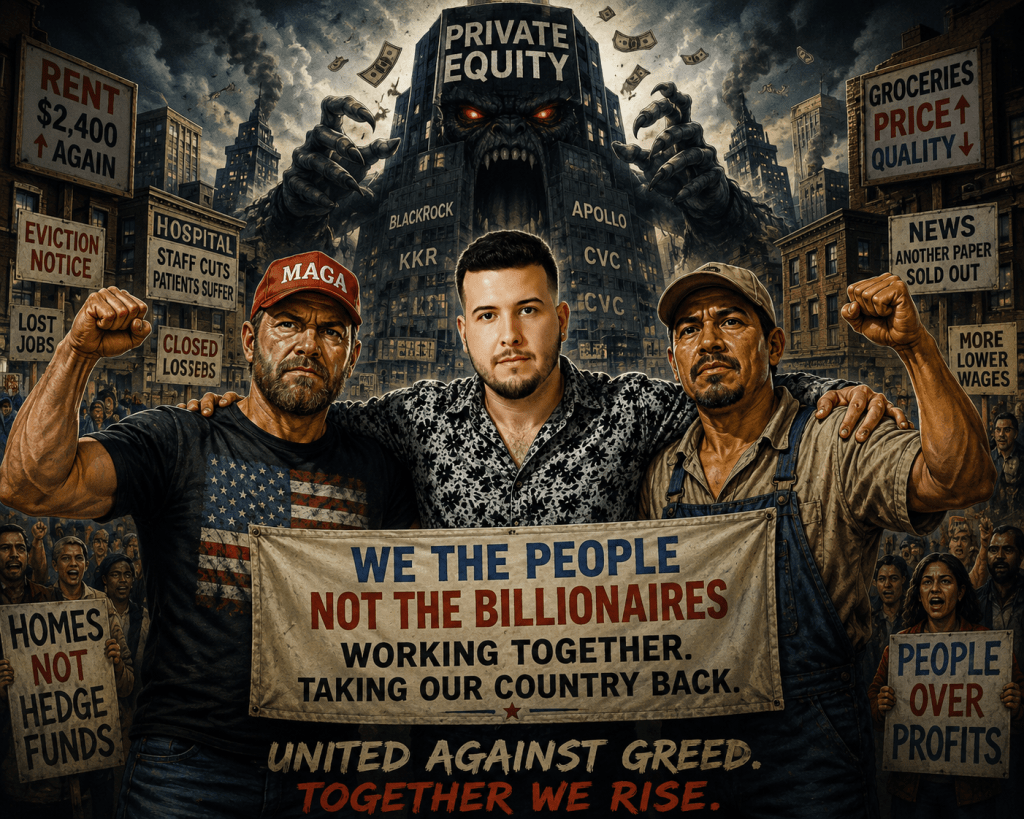
For years, Americans have been told that immigrants are responsible for declining living standards. We are told they take jobs, lower wages, strain public services, and even “replace” Americans. That message has become a staple of right-wing media.
Meanwhile, a far more powerful force has quietly reshaped nearly every aspect of American life: private equity.
Long before most Americans understood what private equity even was, Hollywood often presented corporate financiers as visionaries, investors, or brilliant dealmakers. Films such as Wall Street, Pretty Woman, and Other People’s Money, along with television shows centered around finance and investment, helped normalize the image of the financial elite as ambitious, sophisticated, and worthy of admiration—even when profit came before people. More recently, shows like Billions continued portraying high finance as glamorous and aspirational.
The reality has been far less glamorous for ordinary Americans.
Private equity firms have acquired nursing homes, hospitals, apartment complexes, grocery chains, veterinary clinics, retailers, newspapers, manufacturers, and countless other businesses. Their business model often relies on loading companies with debt, cutting labor costs, selling valuable assets, increasing fees, reducing quality, and eventually selling the company for profit.
The consequences are visible everywhere.
Housing has become more expensive as large investment firms and private equity-backed landlords purchase thousands of homes and apartment buildings, raising rents while reducing maintenance.
Workers are expected to produce more with fewer coworkers after repeated rounds of layoffs designed to maximize quarterly returns.
Consumers pay more while receiving products made with cheaper ingredients, lower-quality materials, or reduced customer service because cutting costs increases profit margins.
Local newspapers disappear after financial owners strip them of resources, leaving communities with less accountability and weaker local democracy.
Healthcare becomes more expensive while patients and medical staff face reduced services as hospitals and physician practices prioritize financial returns.
And let’s stop pretending this happened by accident. Politicians like Mitt Romney built fortunes through private equity before entering politics. Bain Capital made Romney enormously wealthy through leveraged buyouts and corporate restructuring—a business model critics argue often rewarded layoffs, debt-loading, and cost-cutting to maximize investor returns. While conservative media spent years telling working Americans that immigrants were the reason their lives were getting worse, many of the politicians they supported had spent decades championing the very financial system that hollowed out communities, closed factories, squeezed workers, and prioritized Wall Street over Main Street. Americans were told to blame the family crossing the border instead of asking why billion-dollar financial firms were buying up their neighborhoods, cutting jobs, and squeezing every last dollar out of the economy. That’s one hell of a bait-and-switch. The people busting their asses every day weren’t being screwed by immigrants—they were being screwed by an economic model that rewarded financial extraction while politicians and television personalities pointed their anger toward the most politically convenient scapegoat.
Yet instead of discussing these structural economic changes, many political commentators encourage Americans to direct their anger elsewhere.
Fox News host Tucker Carlson warned that immigration would make America “poorer, dirtier, and more divided.” Laura Ingraham famously argued that “the America we know and love doesn’t exist anymore” because of demographic change. Jesse Watters has repeatedly framed immigration as one of the greatest threats facing the country.
Whether one agrees with those arguments or not, they direct public attention toward immigrants rather than toward corporate financial practices that have reshaped the economy over decades.
The irony is striking.
The Haitian family opening a restaurant is not the reason your rent increased.
The Mexican construction worker is not the reason your grocery bill keeps climbing while packages keep shrinking.
The immigrant nurse is not the reason your hospital has fewer staff members.
The refugee family is not responsible for a private equity fund purchasing your apartment building and raising your rent.
Private equity has quietly reduced Americans’ standard of living across nearly every sector of daily life. It has transformed housing into an investment vehicle, workplaces into cost-cutting exercises, healthcare into financial engineering, and consumer products into opportunities for shrinking quality while increasing prices.
If there is something diluting the American standard of living, it is not the immigrant searching for opportunity.
It is an economic model that rewards extracting value instead of creating it.
Americans are encouraged to believe they are completely free while many work longer hours, pay higher rents, carry greater debt, own less property, and have fewer choices than previous generations. Economic dependence has become normalized, even celebrated as market efficiency.
That should concern conservatives, liberals, independents, and democratic socialists alike.
The question facing America is not whether immigrants are changing the country.
The question is whether financial extraction has changed it more.
For too long, public outrage has been aimed at the people with the least economic power while those with the greatest financial power quietly transformed the economy in ways that touch every American household.
Perhaps it’s time we looked in a different direction.
By Jonathan Marquez and Duck.ai
 Truth Crave
Leave a comment