There are moments when a vote in Congress becomes more than a vote.
There are moments when elected officials are not merely deciding how much money to spend, which weapons to purchase, or which military program to authorize.
There are moments when Congress makes a decision about who America is.
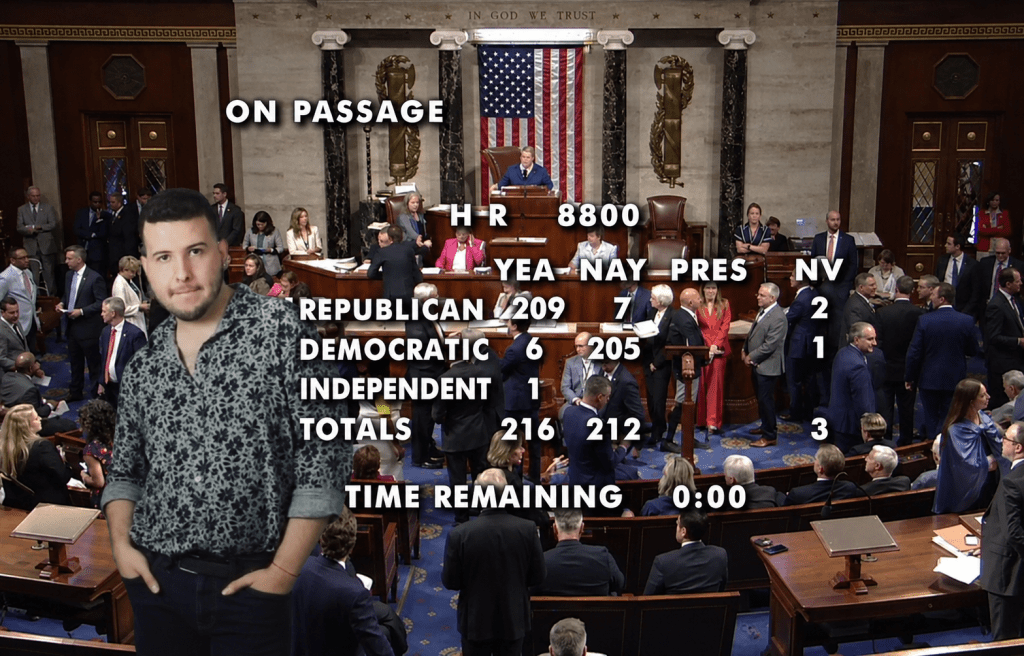
On July 22, 2026, the House of Representatives passed the $1.15 trillion National Defense Authorization Act by a vote of 216–212. The bill now moves to the Senate. But buried within this enormous military package is a provision that should alarm every American who believes the United States should remain a sovereign nation capable of making its own military, intelligence, technological, and foreign-policy decisions.
That provision is Section 219: the United States-Israel Defense Technology Cooperation Initiative.
It is not simply a traditional defense agreement.
The provision would deepen the integration of the United States and Israel across some of the most sensitive areas of modern warfare and national security—including artificial intelligence, cyber defense, biotechnology, network integration, data fusion, research, development, testing, and defense systems.
And that is why this should be understood as a question of American sovereignty.
The United States should not surrender control over its own military architecture
A sovereign nation should be able to determine independently:
- What intelligence it collects.
- How that intelligence is used.
- Which military systems it integrates.
- Which foreign governments receive access to sensitive technology.
- How its artificial intelligence systems are developed and deployed.
- Whether its military-industrial base is tied to another nation’s military objectives.
But Section 219 moves the United States in the opposite direction.
It institutionalizes a deeper relationship between the American and Israeli defense establishments—not merely through ordinary cooperation between allies, but through a legally embedded framework for technological and military integration.
That distinction matters.
There is a difference between the United States cooperating with another country and the United States creating systems that increasingly intertwine its own military, intelligence, technology, and defense industries with that country.
The former can be a diplomatic choice.
The latter can become a structural dependency.
And once these systems are built, once the networks are connected, once the data pipelines are integrated, once defense contractors and military programs become intertwined, reversing that relationship becomes extraordinarily difficult.
This is how sovereignty can be surrendered—not through a formal declaration, but through a series of legislative decisions that make separation increasingly impossible.
The timing makes this betrayal even more disturbing
Congress is not making this decision in a political vacuum.
The Israeli government and military have faced widespread international condemnation over the devastation in Gaza and allegations of serious violations of international humanitarian law. Human-rights organizations have warned that deeper U.S.-Israeli military integration could further entangle the United States in those actions.
And yet, at precisely this moment, Congress is moving to deepen the relationship.
That raises a basic moral and constitutional question:
Why would the United States voluntarily bind its military and intelligence infrastructure more closely to a foreign government accused of genocide and other grave abuses?
The answer cannot simply be “because Israel is an ally.”
Alliances are not supposed to mean unconditional submission.
An ally is not a sovereign superior.
A foreign government is not supposed to become so deeply embedded within America’s military and intelligence infrastructure that questioning the relationship is treated as political heresy.
The United States is supposed to have its own interests.
Its own constitutional obligations.
Its own independent foreign policy.
Its own moral responsibility.
America should not be branded by another government’s actions
The United States already faces a crisis of credibility around the world.
For decades, American presidents have claimed that the United States supports democracy, human rights, international law, and the rules-based global order.
But those principles lose credibility when Washington condemns certain governments for violating international law while providing political, military, technological, and intelligence support to another government accused of committing grave abuses.
And now Congress wants to go even further.
It wants to institutionalize the relationship.
This is not simply about Israel.
It is about America’s identity.
When the United States binds its most advanced military and intelligence systems to a foreign government, it also risks binding its own reputation to that government’s conduct.
When that government is accused of mass atrocities, the United States does not remain morally untouched by the relationship.
The American flag becomes associated with the weapons.
American technology becomes associated with the systems.
American intelligence becomes associated with the operations.
American taxpayers become associated with the infrastructure.
And American soldiers and intelligence personnel may eventually be placed in situations where the interests of the United States and the interests of a foreign government are no longer clearly separable.
That is not strength.
That is strategic entanglement.
The American military should serve the American people
The United States has a military-industrial complex powerful enough to influence policy in Washington.
It has defense contractors that profit from perpetual war.
It has intelligence agencies with extraordinary technological capabilities.
It has corporations seeking access to government contracts and military research.
The last thing America needs is to make this system even more deeply integrated with a foreign military establishment.
The question should not be:
How much more can we integrate?
The question should be:
What exactly are we integrating—and who ultimately benefits?
The American people deserve transparency.
They deserve to know what data will be shared.
What technologies will be developed jointly.
What military systems will be connected.
What intelligence will be exchanged.
What safeguards will exist.
And most importantly:
Can the United States still independently shut down that relationship if the foreign government violates international law or acts against American interests?
If the answer is no, then we are not talking about a normal alliance.
We are talking about a loss of sovereign control.
Congress has a responsibility to America first
The United States should have allies.
But America should not have a foreign military embedded so deeply into its defense and intelligence infrastructure that political leaders become afraid to question the relationship.
That is not an alliance based on mutual respect.
That is dependency.
And dependency is the enemy of sovereignty.
The House’s passage of this NDAA should therefore be remembered as a moment of profound political betrayal—not because America is forbidden from cooperating with other countries, but because Congress is moving to create a level of military and technological integration that could compromise America’s ability to act independently.
The United States should not be required to share its most sensitive military capabilities with any foreign government without extraordinary scrutiny.
The United States should not be permanently tied to the actions of a foreign government accused of genocide.
The United States should not allow its military-industrial and intelligence infrastructure to become indistinguishable from that of another nation.
And the American people should not be told that opposing such a policy makes them anti-American.
In fact, the opposite may be true.
To defend American sovereignty is to insist that America’s military serves America.
To defend American democracy is to insist that foreign governments do not become embedded within the systems that determine America’s security.
To defend America’s moral standing is to refuse to allow the American flag, American technology, American intelligence, and American taxpayer money to become permanently associated with alleged war crimes and mass atrocities.
This is not about abandoning diplomacy.
It is not about abandoning the people of Israel.
It is not about hostility toward Jewish people or Judaism.
It is about the basic principle that no foreign government should be granted unchecked influence over the military and intelligence architecture of the United States.
The United States is supposed to be a sovereign nation.
Not an extension of another country’s military-industrial complex.
Not a permanent financial sponsor of another government’s wars.
Not a technological partner without moral limits.
And not a country that sacrifices its independence in the name of an alliance it is no longer allowed to question.
The House has now passed this bill.
The Senate has the opportunity to stop this dangerous entanglement.
Because if America cannot decide for itself where its intelligence goes, how its military technology is used, and when it is willing to sever cooperation with a government accused of genocide, then the question is no longer whether American sovereignty is being threatened.
The question is:
How much of it has already been surrendered?
 Truth Crave
Leave a comment