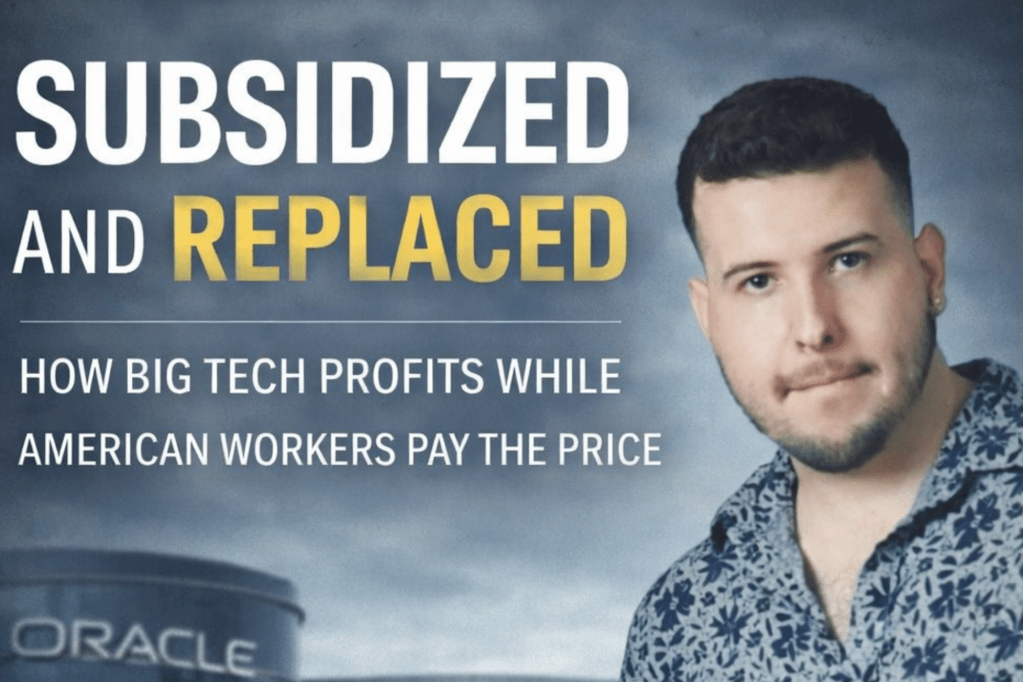
Over the past two fiscal years, companies like Oracle and Amazon have reportedly filed thousands of H-1B visa petitions while simultaneously cutting thousands of jobs held by U.S.-based workers. That contrast should force an uncomfortable but necessary question: what exactly are taxpayers getting in return for the billions in public subsidies these corporations have received?
The H-1B visa program was designed to fill genuine gaps in the domestic labor market—highly specialized roles where employers cannot find qualified workers in the United States. But when companies that have access to vast domestic talent pools continue to downsize American workers while expanding their reliance on temporary foreign labor, it begins to look less like necessity and more like cost optimization. Labor is often cheaper, more dependent, and less likely to push back under visa constraints. That may make sense on a balance sheet, but it raises serious concerns about fairness and public accountability.
At the same time, these same corporations have benefited from extensive corporate welfare: tax breaks, subsidies, infrastructure support, and government contracts worth billions. These incentives were justified as investments—tools to stimulate job creation, economic growth, and long-term national competitiveness. But if the outcome is workforce reduction at home paired with increased reliance on imported labor, then the public has every right to question whether those investments delivered what was promised.
This is not an argument against immigration or against high-skilled foreign workers. The United States has long benefited from global talent, and that should continue. The issue is alignment. If companies accept public money under the premise of strengthening the domestic economy, they should be held to that standard.
There are several reasonable policy responses. One is conditional subsidies: tie tax incentives and public funding directly to measurable domestic job creation and retention. Another is transparency—require companies to clearly disclose the relationship between layoffs and visa hiring. A third is accountability: if corporations fail to meet agreed-upon benchmarks, there should be clawback provisions requiring them to repay the subsidies or stop operating completely.
Right now, the system allows companies to benefit on both ends—public support on one side and labor cost flexibility on the other—without meaningful consequences. That imbalance erodes public trust and fuels resentment that ultimately harms both economic stability and social cohesion.
If corporate welfare is truly an investment, then it should come with expectations and enforceable outcomes. Otherwise, it’s not an investment at all—it’s a subsidy with no strings attached, paid for by the very workers who are being left behind.
At the same time, the rapid acceleration of automation—especially through advances in artificial intelligence—is fundamentally changing the equation. Corporations are no longer just substituting foreign labor for domestic workers; they are increasingly replacing both with machines. In that context, continuing to subsidize these companies makes even less sense. Public money is meant to generate shared prosperity, not to underwrite systems that extract value while reducing the need for human labor altogether. When corporations use taxpayer support to automate jobs, cut their workforce, and concentrate wealth upward, the social contract breaks down. If these firms are no longer reliably creating jobs or broadly distributing economic gains, then the rationale for supporting them with public funds weakens significantly. At minimum, subsidies should be reconsidered—and at most, phased out entirely—unless companies can demonstrate a clear, measurable return to society.
By Jonathan Marquez and DeepSeek
 Truth Crave
Leave a comment