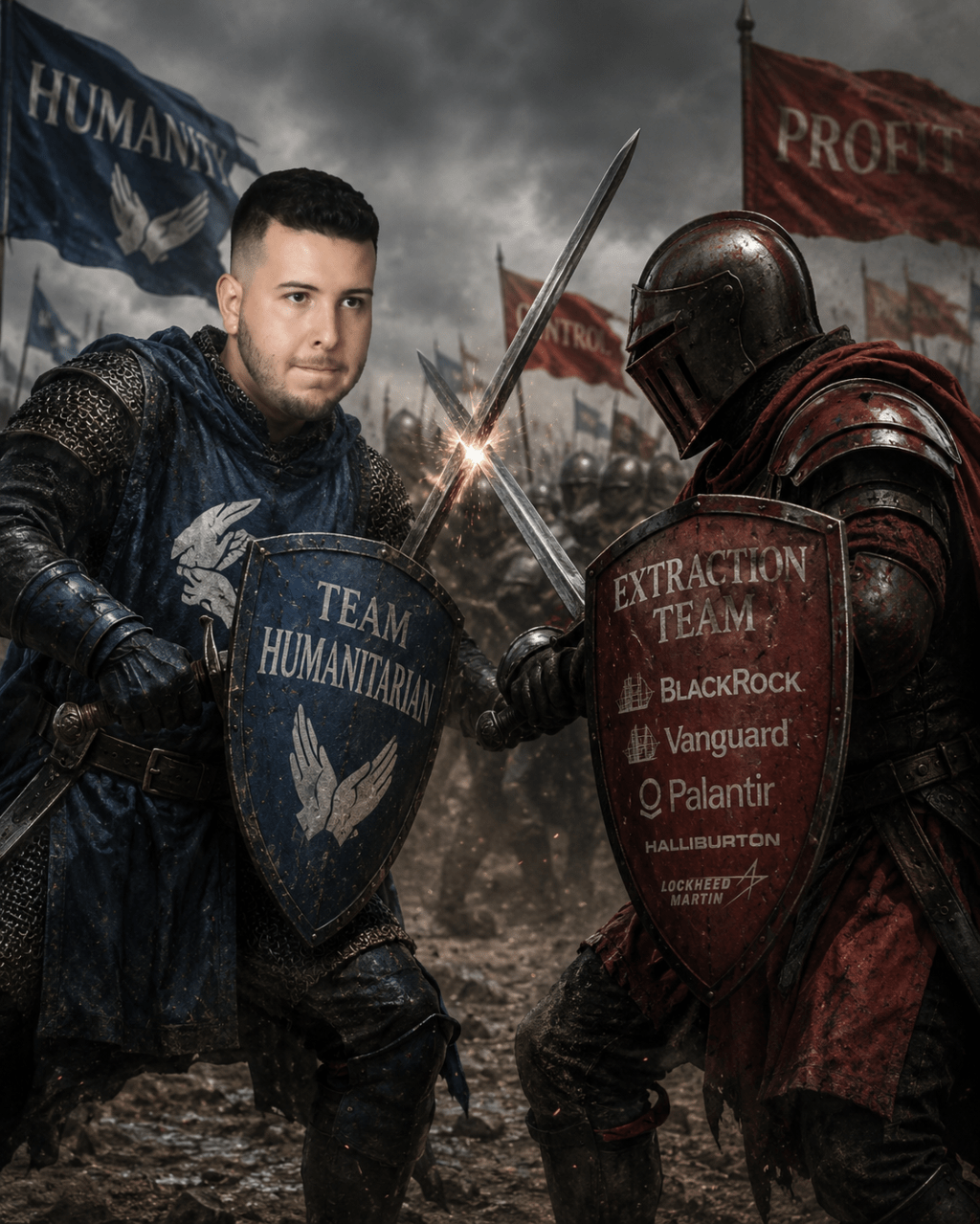
The United States has a new mission for the Western Hemisphere. Donald Trump calls it the Shield of the Americas. The name sounds defensive. Almost noble. But nothing is ever is with him. According to the Trump administration, this new regional coalition is meant to confront drug cartels, organized crime, and what Washington calls “narco-terrorism.” Twelve Latin American leaders gathered with Trump in Miami as the United States sought to build a regional alliance against cartels and, increasingly, against Chinese influence in the hemisphere.
But before we accept the branding, we should ask a simple question:
Who exactly is standing behind the shield?
Because the Shield of the Americas is not merely a security alliance. It is also a political alliance of the most corrupt right wing politicians. Across Latin America, the political right has increasingly learned how to coordinate across national borders. Leaders who share little in common culturally or economically can still unite around a common political project: hostility toward the left, hostility toward governments that challenge Washington’s right wing and Zionist corruption, aggressive anti-immigration politics, deadly military solutions to social problems, and a willingness to treat political opposition as a security threat. The USA and Latin American left, meanwhile, remains fragmented. That difference matters. Because the political right is not simply winning individual elections. It is building a regional network. And the Shield of the Americas appears to be part of that larger project. The propagandized justification is the war on drugs.
But the first problem is obvious:
A coalition cannot claim to be fighting narco-power while selectively ignoring the political relationships between power, corruption, business, and organized crime.
Consider Honduras. Juan Orlando Hernández was not some anonymous cartel associate hiding in the countryside. He was the president of Honduras. In 2024, a U.S. federal jury convicted Hernández of conspiring to import cocaine into the United States and related weapons offenses. He was sentenced to 45 years in prison. Prosecutors argued that he used his political power to facilitate the movement of enormous quantities of cocaine. Then, in December 2025, Donald Trump pardoned him. Hernández was released. The president who had been convicted in the United States of helping facilitate cocaine trafficking was suddenly free.
At almost the same time, Trump was openly supporting conservative Honduran candidate Nasry Asfura in the country’s presidential election. Asfura was eventually declared the winner after a delayed vote count marked by allegations of irregularities and criticism of U.S. interference, something clearly anti democratic. The message was difficult to miss. A politician convicted of helping drug traffickers could receive a presidential pardon. But the United States could still present itself as the leader of a new hemispheric war against drug trafficking.
This is not a minor contradiction.
It is the central contradiction.
If the war on drugs is truly about stopping the movement of cocaine, then the war cannot end with the person carrying the package. It has to reach the people who control the ports. The companies that move the containers. The banks that wash the money. The right wings politicians who protect the networks. And the governments that decide which criminals are enemies and which criminals are useful allies.
Ecuador presents another uncomfortable example. President Daniel Noboa has positioned himself as one of the region’s most aggressive leaders in the fight against organized crime. His government has embraced a militarized approach to the drug crisis.
But investigative reporting has also documented cases in which cocaine traffickers allegedly used banana shipments connected to Noboa Trading, a company tied to his family. Noboa has denied personal involvement and said the company cooperated with authorities. But lets be real Chiquita and United Fruit have a long history of unethical, violent and corrupt behavior.
But it does raise a question that the political establishment would prefer to avoid:
Why does the war on drugs always seem to focus on the people at the bottom while the political and economic structures surrounding the drug trade remain protected from the same level of scrutiny?
The drug trade does not operate through poor neighborhoods alone. It operates through international shipping. Through ports. Through financial institutions. Through corporations. Through political protection. And through governments. The cocaine does not magically appear in Europe or the United States. It travels through systems. And systems have owners. That is why the Shield of the Americas deserves skepticism. Not because the cartel threat is imaginary. It is not. Latin America is experiencing a genuine crisis of organized crime and political violence. But the question is whether the United States intends to confront the entire systematic problem—or only the parts of the system that are politically convenient to attack.
History gives us reason to be suspicious.
For decades, Washington claimed that military intervention in Latin America was necessary to defend democracy and fight communism. The result was often the opposite. Governments were overthrown. Dictatorships were supported. Political opponents were disappeared. Entire societies were militarized. And the language of national security was used to justify crimes against humanity in Latin America by the hands of corrupt American Governments of the past.
The Cold War created a political formula:
If a government was friendly to Washington, its authoritarianism could be tolerated. If it was hostile to Washington, even democratic reforms could be treated as a threat.The enemy changed. The formula did not. Today, communism has largely been replaced by a new collection of enemies: Cartels. Narco-terrorists. Migrants. China. The Imaginary Latin American Radical left. The vocabulary is different. The political function can be remarkably similar. The United States identifies a threat. It builds a coalition. It selects allies. It militarizes the region. And then it decides which governments are legitimate based not only on how they govern their own people, but on whether they serve Washington’s Pedo-PayPal mafia geopolitical interests. This is why the political composition of the Shield of the Americas matters.
It is not a neutral gathering of governments united by a single criminal threat.
It is emerging at a moment when the American right is attempting to consolidate a hemispheric political bloc.
Donald Trump has made clear that he views Latin America not simply as a region of independent nations, but as a battlefield in a larger struggle against the left, China, migration, and perceived threats to American dominance.
The new alliance therefore serves multiple purposes. It can be presented as a war against the cartels. It can be used to justify military cooperation. It can strengthen conservative governments. It can isolate left-wing governments. And it can reinforce Washington’s Pedo-PayPal mafia influence over the Western Hemisphere.
This is not a conspiracy theory. It is how international politics works. Governments build alliances around shared interests. The question is not whether the alliance has political interests. The question is whether the public is being told the truth about them.
Because if the Shield of the Americas is genuinely about fighting organized crime, then its standards must be universal. The same standard must apply to a cartel leader and a corrupt American president. To a street-level trafficker and a corrupt political donor. To a criminal organization and a corporation whose infrastructure is used to traffic cocaine or exploit people. To a left-wing government and a right-wing government. To an enemy of Washington and an ally of Washington. Otherwise, this is not a war against narco-power. It is a war against political opponents of The Pedo-PayPal mafia’s interest.
And that is something very different.
The United States cannot claim to be fighting the drug trade while pardoning a former president convicted of facilitating cocaine trafficking. It cannot claim to be defending democracy while openly intervening in the elections of foreign nations. It cannot claim to be protecting Latin America while treating the region as a chessboard for American geopolitical interests. And it cannot claim to be building a shield for the people while refusing to examine who is actually holding it. The greatest danger is not that the Shield of the Americas will fail to eliminate the drug trade.
The greater danger is that it will succeed at something else.
It may create a militarized political bloc across the hemisphere. A bloc in which governments are rewarded for loyalty to The Zionist Pedo-PayPal cartel in Washington. A bloc in which the left is treated as a security threat. A bloc in which corruption becomes tolerable when committed by The Zionist Pedo-PayPal cartel allies. A bloc in which democracy is defended only when the election produces the right result for The Zionist Pedo-PayPal cartel in Washington.
And a bloc in which the war on drugs becomes a permanent justification for expanding political power. The people of the Americas do need protection. They need protection from cartels. They need protection from corruption. They need protection from political violence.
But they also need protection from governments that use fear to expand their power as Washington has done in the past. They need protection from militarized corporations that profit from the political instability they generate. They need protection from right wings politicians who condemn organized crime while protecting the networks that make organized crime possible. And they need protection from a foreign policy that repeatedly claims to be defending democracy while choosing allies based on extremist right wing political loyalty.
So perhaps the real question is not whether the Americas need a shield.
Perhaps the question is:
Who is the shield protecting?
Because if it protects the people from the cartels, it may be worth defending. But if it protects corrupt right wing politicians from accountability, militarized corporations from scrutiny, and a extremist right wing political ideology from democratic opposition, then the name begins to sound less like a promise of security.
And more like a threat to democracy and human rights.
The Shield of the Americas may not be a shield against Narco power.
It may be a shield against accountability for the Pedo-PayPal mafia in Washington.
By Jonathan Marquez and DeekSeek
Make a one-time donation
Make a monthly donation
Make a yearly donation
Choose an amount
Or enter a custom amount
Your contribution is appreciated.
Your contribution is appreciated.
Your contribution is appreciated.
 Truth Crave
Leave a comment